


TL;DR
This essay argues that enough is a psychological threshold and a societal design choice. Modern consumer culture depends on manufactured dissatisfaction, amplified by social comparison and industrialised by advertising and platforms. Once basic needs are met, the returns shift to relationships, autonomy, competence, and meaning that drive wellbeing far more reliably than upgrades and status goods. The punchline is that if we want a post-growth world that doesn’t feel like punishment, we’ll have to build systems and habits that make contentment normal instead of suspicious.
All Boomers like myself were born after World War II; yet many of us are fascinated by those horrific events. Between 70 and 85 million people died from starvation, disease, genocides, strategic bombings and combat-related fatalities. This was about 3% of the world’s population at the time. Few would have escaped the trauma.
After the attack on Pearl Harbour in December 1941, most civilian manufacturing in the US was suspended and factories that had made cars, appliances, or textiles shifted to tanks, bombers, and uniforms. By 1945, U.S. war industries were outproducing the combined efforts of all the Axis powers.
During the war, over one-third of U.S. GDP was devoted to military output, and over 17 million civilians were employed in defence industries.
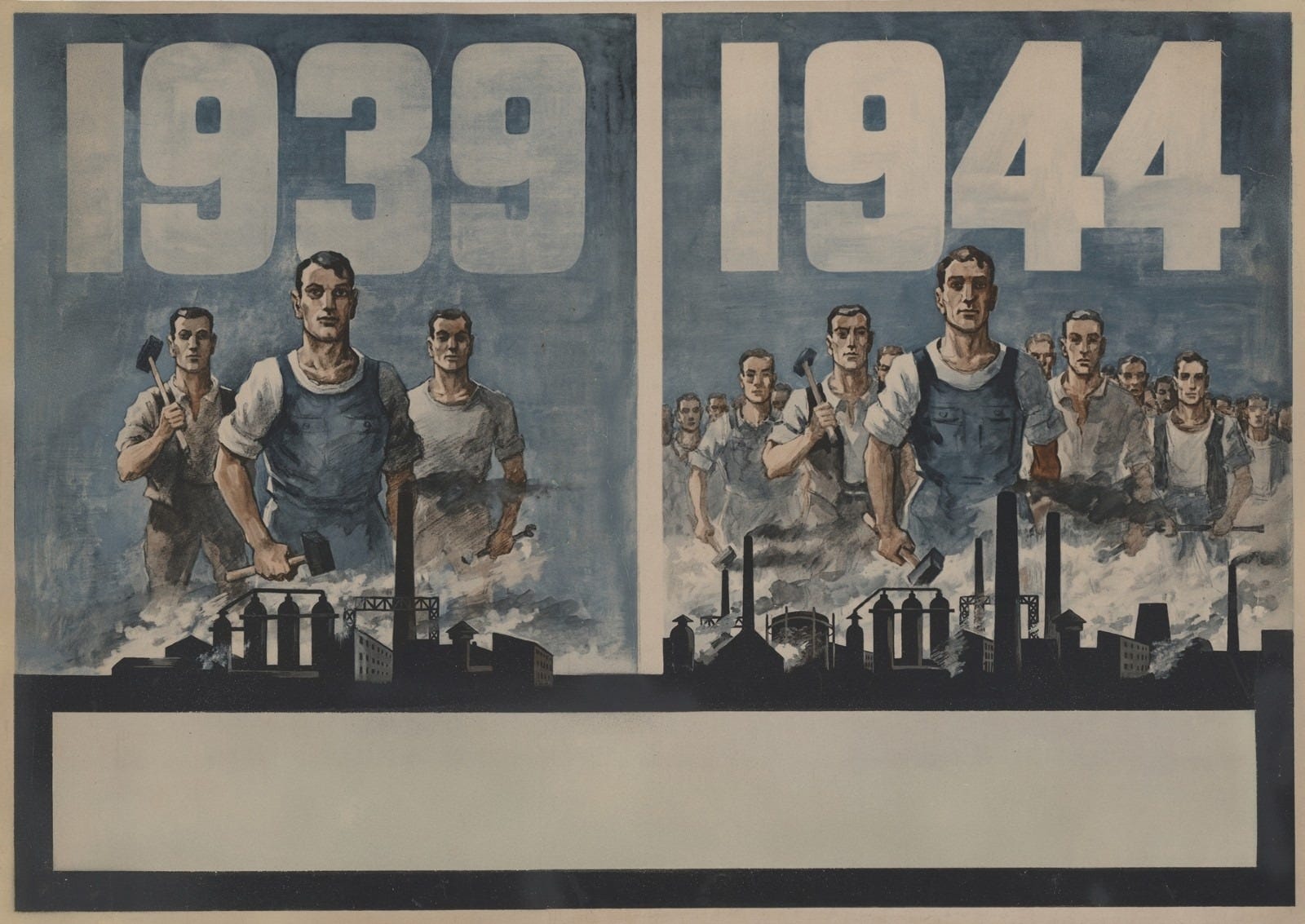
And it wasn’t just that there were factories with millions of workers. What went on inside them had changed drastically. They were way more efficient, productive and profitable. When the war ended, that capacity didn’t evaporate. It needed a new job.
Techniques of mass production, assembly-line efficiency, and standardised parts perfected during the war were applied to consumer goods, making them more affordable and accessible to the growing middle class. Wartime scientific advances in materials, particularly plastics and synthetic fabrics, electronics, and communication technologies, were repurposed for civilian use. This technological inheritance from war production helped accelerate the adoption of convenience-oriented domestic life.
People who had gone without new cars or appliances during the war years were eager to spend, and businesses capitalised on this appetite with aggressive marketing. Credit systems also expanded, making consumer purchases more attainable. This ushered in the so-called Golden Age of Capitalism, when consumer spending became the dominant driver of economic growth and a proxy for national prosperity. The mad men had a ball.
In the blink of an eye, or was it a wink, the war machine became a consumer machine that had to be fed. Its voracious appetite was sustained in postwar America through a deliberate combination of advertising, suburban development, and cultural messaging that equated personal consumption with freedom, modernity, and patriotic duty. People were showered with goods and opportunity.
The expansion of all forms of consumer credit, from charge accounts and instalment plans to credit cards, allowed people to purchase goods they could not immediately afford, effectively pulling future consumption into the present. Home loans guaranteed by the Federal Housing Administration and Veterans Administration enabled millions of families to buy homes in the suburbs, creating demand for furnishings, cars, and appliances. This cycle of credit and consumption, which fuelled economic growth, was reinforced by policies favouring low interest rates, tax deductions for mortgage interest, and infrastructure spending, including the Interstate Highway System, that supported a car-based consumer lifestyle.
Culturally and ideologically, consumerism was framed as a cornerstone of American life and values, especially during the Cold War. The ability to buy and own goods was presented as a personal achievement and a symbol of American democracy and superiority over communism, a message echoed in political rhetoric, school curricula, popular media, and even international propaganda. The American Dream was redefined. Now it meant homeownership, upward mobility, and material abundance. And the economic system was calibrated to stimulate continuous consumption through planned obsolescence, seasonal fashion cycles, and the constant rollout of new technologies, ensuring that even satisfied customers would return.
Over time, this created a self-reinforcing economy of desire, where consumption became both a social norm and an economic imperative. Everyone forgot about enough and instead thought only about more.
Consumer cultures generate perpetual dissatisfaction to drive continued consumption.
Consumer cultures, particularly in capitalist economies, are built around a dynamic of desire rather than need.
We are told that what we want is a grasp away. Little Johnny and Jenny can grow up to fulfil their desires, so long as those desires are to be better than Joe and Jill. But you have to work for it, or you’ll fall behind. Marketing strategies, product design, and branding create or intensify a sense of lack or inadequacy through aspirational imagery, status signalling, or the promise of self-improvement. This cultivated dissatisfaction keeps consumers in a perpetual search for fulfilment that only the acquisition of goods and services can resolve.
Products are often marketed as extensions of identity, status, or lifestyle, where satisfaction is inherently elusive and endlessly redefined.
Planned obsolescence, both technological and symbolic, reinforces this cycle. In fashion, electronics, automobiles, and almost all consumer goods, products are often deliberately designed with limited lifespans due to material degradation or cultural devaluation as trends shift. This ensures repeat purchases and sustains the economic momentum of industries reliant on continuous consumption.
The message is subtle but persistent… what you have now is not enough, and what will satisfy you is just one purchase away.
Following World War II, America became a caricature of this trend. A place where consumer culture was deliberately shaped to drive economic growth through sustained demand, using dissatisfaction as a central lever. The challenge was no longer how to produce enough because the capacity and capability now existed. The challenge was how to ensure people continued to buy. This led to the strategic deployment of advertising, psychology, and design to cultivate a culture of perpetual upgrade.
Retail analyst Victor Lebow famously articulated this philosophy in 1955, writing that…
our enormously productive economy demands that we make consumption our way of life…that we convert the buying and use of goods into rituals…that we seek our spiritual satisfactions, our ego satisfactions, in consumption.
In essence, satisfaction became both fleeting and commodified, ensuring that new desires would continuously replace fulfilled ones. People often overlook their needs and become fixated on their wants.
TikTok is an insidious symptom. Spend five minutes watching the feed or ten minutes watching a Black Friday queue in a store, and you can see the machine doing what it was designed to do.
Dissatisfaction is maintained with the simple lever of comparison.
You don’t need to get from A to B. You need to do it alone in a luxury car. As a consumer, my thought is that I don’t just want a car. I want one that sits higher than my neighbours’ and looks expensive from forty metres away.
Social comparison drives consumption more powerfully than absolute needs.
People don’t just buy products for their utility. They do it to signify status, identity, and belonging within a social hierarchy.
This is the essence of social comparison theory, first formalised by Leon Festinger in 1954, which suggests that individuals determine their own social and personal worth by comparing themselves to others. In economic terms, this manifests in positional goods, items whose value partly derives from how they elevate someone’s perceived status relative to peers. Think about luxury cars, branded clothing, the latest smartphone, or, in my case, golf equipment.
And social comparison is powerful.
Bizarrely, individuals would prefer to earn $50,000 if others earn $40,000 rather than $60,000, if others earn $70,000. This logic-defying phenomenon drives consumption patterns beyond necessity, fuelling industries such as fast fashion, tech gadgets, and cosmetic surgery.
Social media has dramatically amplified this effect. Scrolling means we are constantly exposed to curated images of others’ lifestyles, ever-shifting benchmarks for adequacy and aspiration. Influencer is a precise label.
And we can’t seem to help it.
We know from evidence and a gut feeling that the absolute needs of food, shelter, and basic clothing motivate consumption only up to a sufficiency threshold. And once those are met, additional consumption rarely yields proportional increases in well-being; satisfaction from material gains diminishes over time. We know this, but we consume more anyway.
But it is not just diminishing returns. Social comparison is also a driving force behind chronic dissatisfaction, fuelling continual consumption even when we are already overwhelmed with possessions. Thus, consumer culture thrives not on need, but on the perception that others have more, better, or newer.
Maslow’s hierarchy reminds us that physiological needs form the basis of our priorities, and purchasing patterns do provide some support for this. Food staples like grains and vegetables exhibit price inelasticity, meaning people continue to buy them regardless of cost fluctuations. They’re non-negotiable necessities.
The social layer arrives early. Even in poorer settings, people allocate some spending to signalling because belonging isn’t a luxury need. For example, research in Peru suggests that even in impoverished communities, while 78% of spending directly satisfies basic needs, 22% still serves social signalling. This pattern suggests our social needs begin asserting themselves well before physical necessities are fully secured.
In the wealthy world, the share of household budgets devoted to basic needs is historically low. According to the USDA Economic Research Service (ERS), in 2024, U.S. consumers spent an average of 10.4% of their disposable personal income on food. Whereas in countries like Nigeria, Kenya, and Myanmar, food often accounts for 50% to 60% of total household spending. This phenomenon is known as Engel’s Law, which states that as income rises, the proportion of income spent on food falls, even as total spending increases. This gap is quickly filled by comparison-driven consumption, with 68% of middle-income consumers reporting that they overspend simply to keep up, and roughly 35–45% of Millennials and Gen Z admitting they spend more than they can afford to keep up with what they see on social media.
We can argue over exact percentages, but the direction of travel isn’t in doubt. Status drives discretionary spending, and the social platforms industrialise envy to take advantage.
There is also a lock-in effect that blurs the boundaries between absolute requirements and socially constructed ones. For example, our infrastructure choices create pseudo-necessities, such as car dependency in suburbs… How will I get to work without the car?
Across luxury, tech, and travel, purchasing is often a social act before it is a functional one. The strongest signal is not what the product does, but what it implies about the owner inside their circle. Economists have a name for this, the relative income hypothesis. We don’t calibrate consumption against some clean, absolute income line. We calibrate it against the people we compare ourselves to.
Social media widens that comparison set and keeps the gap visible. In luxury, that has made pre-owned goods a primary on-ramp for buyers who want status without paying the full ticket price. Tech runs the same script. The pull of social parity can outweigh hardware utility, so perfectly functional devices get replaced simply to stay in the pack.
So luxury consumption is now less about function and more about deliberate signalling. Now you know why it makes economic sense for companies to sponsor social media influencers with modest followings. They are the ultimate peddlers of status signalling. Think about that next time the TikTok feed sends you a fit youngster with a new chia seed recipe.
We can debate the precision of any statistics associated with these phenomena, but there is little to doubt that status drives buyers, even the well-educated and aware.
I could provide endless examples, from organic food adoption rates to house sizes to SUV purchases, but a brief explanation of why there is never enough is instructive.
Social comparison triggers dopamine responses 23% stronger than absolute need satisfaction, creating addictive consumption patterns that reshape entire economies. In subsistence economies with a per-person income of less than $2,500, 85% of consumption choices are driven by absolute needs. This shifts dramatically to 55% social comparison in developing economies, and 72% in advanced economies with earnings above $15,000.
Three-quarters of our choices!
Once we have enough, we don’t stop; we keep going until we have more than Joe and Jenny.

What does this tell us about consumption?
Social comparison dominates discretionary spending in developed societies, but crucially, this rests upon the prior satisfaction of absolute needs. Basic needs are met, but this is not enough. We fulfil the desire for more with discretionary spending to make us appear better than others.
Modern marketing exploits this want with glee. It offers $8 designer water, transforming necessities into status symbols, and creates artificial scarcity through limited editions and VIP access.
So, do we know how to counteract this psychology of never being enough? What is there to do when people tend to be driven increasingly by wants and social comparison as the economy advances?
A simple solution is to reiterate Maslow’s hierarchy and remind us all that our basic needs are met, and that well-being doesn’t have to be about stuff that signals status.
Psychological research identifies pathways to well-being unrelated to material consumption, and historical and cross-cultural examples demonstrate high well-being with modest material footprints.
Research repeatedly identifies key determinants of happiness and life satisfaction that have nothing to do with stuff. Strong social relationships, a sense of meaning or purpose, engagement in fulfilling activities, and a sense of autonomy and competence individually and in combination do more to satisfy us than a bigger house or an $8 bottle of water.
In many traditional and Indigenous societies, people have maintained strong communal bonds, meaningful rituals, and ecological harmony without the trappings of consumer culture. For example, studies of the Hadza in Tanzania or Quechua communities in the Andes reveal high life satisfaction despite limited material wealth, primarily due to strong kinship networks, shared cultural meanings, and minimal status competition. Similarly, post-war Scandinavian countries, even during times of modest affluence, invested heavily in social infrastructure and egalitarianism, producing high levels of well-being rooted more in social security and trust than consumption.
Moreover, contemporary research on voluntary simplicity and minimalist lifestyles suggests that many individuals in high-income societies report increased life satisfaction when they intentionally reduce consumption and focus on meaningful activities, environmental values, or relational depth. The evidence indicates that human flourishing can be decoupled from material accumulation and is often enhanced when attention is redirected toward intrinsic values and communal life.
The pursuit of meaning may be a powerful path to well-being. Meaning-oriented lives consistently show better health outcomes and greater resilience during hardship. The conventional explanation suggests this is simply a psychological buffer against stress, but a mindful sceptic might recognise something deeper, perhaps our evolutionary heritage as social, tribal beings who thrived through contribution to collective survival. The growing research on post-materialist values indicates that once basic needs are met, further consumption contributes minimally to well-being compared with purpose-driven activities. This suggests our economic systems may be fundamentally misaligned with our psychological needs, prioritising metrics that don’t maximise human flourishing.
Conventional wisdom acknowledges that relationships matter, but our economic systems and technological innovations increasingly monetise, mediate, and sometimes erode our social bonds. The Harvard Study of Adult Development provides compelling evidence that close relationships predict health and happiness more effectively than any other factor, including wealth, status, or achievement. Yet, our most meaningful connections require little material throughput, suggesting an alternative economy built around relationship cultivation might yield far greater well-being returns than consumption growth.
But as with all psychology, nothing is simple. Numerous layers can complicate any cause-and-effect relationship.
Technological advancement liberates us from effort, but that is not enough. Self-Determination Theory suggests that appropriate challenge leads to optimal experiences; if it’s too easy, we are not satisfied. This contradiction helps explain why convenience-enhancing technologies often fail to increase reported life satisfaction. From an evolutionary perspective, our brains evolved to solve problems and overcome obstacles in our environment, processes that trigger neurochemical rewards. Many modern conveniences short-circuit these reward pathways, replacing the satisfaction of earned mastery with hollow consumption experiences. What’s particularly revealing is how many people voluntarily seek out challenges during leisure time, from climbing mountains, learning instruments, or creating art, to engaging in extreme sports, suggesting that our innate drive toward competence remains powerful despite cultural messaging that equates happiness with ease. Maybe we watch sport not for the ritualised combat, but for the desire to see what it takes to be an elite athlete.
The paradox is that we end up with an economy built to remove effort, even though effort may be a core ingredient of human satisfaction.
Books on gratitude and mindfulness are readily available in modern bookstores. Soft colours and simple fonts on their covers stand in stark opposition to the dissatisfaction engine that drives consumer capitalism. Research consistently demonstrates that gratitude interventions increase life satisfaction without altering material circumstances, suggesting that much of our perceived need for more stems from attention patterns rather than an actual lack. And as we have seen, advertising and social media systematically redirect attention toward deficiencies and social comparison, creating an artificial sense of scarcity amid abundance.
What’s striking is how many wisdom traditions arrived at the same attention practices on their own, and then, how often they tied them to material simplicity. Ancient intuition knew the mechanisms for training the mind and loosening the hedonic treadmill.
And the pattern is consistent. These practices tend to raise subjective well-being. That offers a credible alternative to growth-dependent ideas of progress. It offers a version of prosperity that lifts life satisfaction while potentially easing environmental impact.
What becomes evident with even a little digging into the brain is that well-being is not just psychological, but also relational, purposeful, and experiential. That consumption often distracts from rather than supports these foundations means happiness may need to be a social contract, rather than a mindfulness practice.
Let’s suppose that this is the answer and premise that…
Communities practising voluntary simplicity offer practical models for contentment.
Voluntary simplicity is a lifestyle choice that minimises material needs to focus on more meaningful, sustainable, and fulfilling ways of living.
Across cultures and contexts, several communities have adopted this principle not out of necessity, but by design, often as a critique of consumerism or as a spiritual commitment. These groups offer living experiments that demonstrate how well-being can flourish without material excess, instead being supported by community, purpose, and ecological mindfulness.
The Amish of Pennsylvania and other parts of the United States are perhaps the best-known examples. Their lifestyle is centred on religious values, simplicity, family cohesion, and resistance to modern technology. They avoid most forms of consumer culture and live without electricity from public grids, automobiles, or social media. Despite these limitations, studies consistently find high levels of life satisfaction among Amish communities, attributed to strong interpersonal bonds, a clear moral framework, and a slower, less stressful pace of life. Their model illustrates how contentment can arise from consistency, community obligation, and autonomy from consumer pressure.
In southern India, Auroville presents a different but equally intentional form of simplicity. Founded in 1968 as a utopian township, Auroville was designed to promote human unity, ecological sustainability, and spiritual growth over material accumulation. Residents often live in basic dwellings, engage in cooperative labour, and focus on education, organic farming, and meditation. The community experiments with alternative economic models, including a gift economy and communal decision-making. While not without challenges, Auroville demonstrates how shared ideals and modest living can foster resilience, creativity, and satisfaction.
The Bruderhof, an international Anabaptist community with roots in early 20th-century Germany, live in intentional settlements across the U.S., U.K., and other countries. They practice common property ownership, pacifism, and a strong emphasis on equality. There is no private wealth, and all members contribute to and share in the life of the community. Despite, or perhaps because of, their renunciation of consumerism, Bruderhof members often report high well-being, supported by a deep sense of belonging, spiritual purpose, and meaningful daily activity.
These communities, diverse in geography and belief, show that contentment and flourishing can emerge from deliberate limits, not as deprivation, but as liberation from the churn of comparison, accumulation, and ecological overshoot.
They certainly have smaller material and energy footprints.
The Amish rely on horse-drawn buggies or communal vans rather than personal cars, significantly reducing their fossil fuel use. Most Amish homes are off-grid, often relying on minimal solar power, natural gas, or non-electric tools. Much of their diet comes from local, organic, small-scale agriculture, which minimises packaging, refrigeration, transportation, and synthetic fertiliser emissions. Amish homes are often built using local materials and maintained over generations, rather than being demolished or renovated frequently, which reduces construction-related emissions. The Amish way of life represents a viable low-impact model within an industrial society, offering insights into how cultural norms, technology choices, and community structure can reduce environmental burdens without sacrificing well-being.
We can be happy with less, happier even, but since the explosion of widespread consumerism after World War II, we have some inertia to overcome.
Would it be possible to go from hedonistic social climbing to a system of enough?
The transition to “enough” requires both personal practice and systemic change.
Enough is both material sufficiency and psychological contentment. Materially, it means the resources needed for physical well-being, including adequate nutrition, shelter, healthcare, and education. Psychologically, it means satisfaction that is not powered by endless consumption or comparison with others. It also means we need a purpose.
Research suggests that beyond a certain threshold, more wealth does not reliably translate into proportionate gains in happiness or life satisfaction. So a meaningful life becomes a quantitative and qualitative judgment about what actually contributes to it. Enough is reached when essential needs are met and contentment comes through relationships and purposeful activities rather than excess goods. We know what enough could look like.
Structurally, that requires a hard reset on what counts as economic success. Liberal democracies tend to treat GDP growth and consumer spending as prosperity, which rewards production and consumption even when the social and environmental costs are high. Moving toward enough means shifting metrics to well-being indicators such as the OECD’s Better Life Index or Bhutan’s Gross National Happiness, ecological sustainability such as the planetary boundaries, and social equity. It also means regulating advertising, incentivising repair and reuse economies, and redesigning tax systems to penalise waste and pollution while supporting low-carbon public infrastructure in housing, transport, and energy.
Most of all, it requires giving up growth as the defining paradigm.
Culturally and locally, the work is to rewrite desire. Consumer capitalism runs on dissatisfaction and competitive acquisition, amplified by marketing and social comparison. A transition to enough elevates sufficiency, care, community, and reciprocity, supported by education that builds ecological literacy, civic responsibility, and emotional resilience. Journalism, film, literature, and the arts can make post-consumerist life feel aspirational rather than austere. At the individual and community level, enough looks like voluntary simplicity, conscious consumption, and relational living, helped by systems that make low-carbon choices easier, including walkable neighbourhoods and workplaces that allow shorter hours and job sharing. Religious, spiritual, and philosophical traditions can also help re-root values of humility, stewardship, and sufficiency.
Ultimately, enough is a cultural transformation of desire and a collective reimagining of how to live well together on a finite planet.
At risk of boredom and a little incredulity, let’s break this down some more in Scandinavia.
Nordic countries routinely rank highest in life satisfaction, largely because of strong community bonds and institutional trust rather than luxury consumption, even if many will point out they have that too. The evidence also suggests that purposeful engagement, especially intergenerational activity, improves mental well-being by building meaningful connection and reducing isolation.
Autonomy also correlates strongly with happiness, particularly in societies with robust democratic institutions that protect individual agency while maintaining social cohesion. What stands out is that these psychosocial needs can deliver outsized well-being gains with relatively low resource throughput. That points to a possible decoupling of human flourishing from high-consumption lifestyles.
Enough does not flourish accidentally. It depends on governmental and social institutions. Liberal democracies can build frameworks for sufficiency through universal welfare systems that meet basic needs, civil liberties that protect expression and assembly, and progressive taxation that funds public goods like education and healthcare. These conditions let people pursue fulfilment without constant material insecurity.
Denmark and Norway show what enough can look like in practice. They sustain sufficiency through high social expenditure at 25 to 30 percent of GDP, support for work-life balance, a cultural prioritisation of leisure and family time over accumulation, and labour protections that secure living wages without excessive hours. They maintain economic viability and exceptional quality of life by investing in human capabilities rather than maximising consumption.
The Nordic paradigm suggests a third way, beyond the false binary of growth versus austerity that shapes many debates in other liberal democracies. Their welfare model is a social contract that provides universal healthcare, comprehensive education through university, and robust safety nets including unemployment benefits, parental leave, and pensions that reduce economic insecurity. Their consistent top ranking in the UN World Happiness Report suggests something simple and significant. Security in these basic domains is what makes contentment possible.
Perhaps the most revealing of all is the consistent evidence for threshold effects in the relationship between wealth and well-being. Beyond an annual household income of approximately $75,000 (U.S. equivalent), additional wealth shows diminishing returns for life satisfaction. At this point, psychological needs dominate well-being outcomes—quality relationships prove seven times more impactful on happiness than income. At the same time, a sense of community belonging and opportunities for lifelong learning and creativity become central to fulfilment.
There is no reason these psychological dimensions cannot thrive in much lower material-throughput economies, and enough can emerge when societies guarantee material security while cultivating environments where social bonds and personal growth outweigh status competition. Crucially, this balance is achievable in liberal democracies through institutionalised rights and welfare safeguards. We could engineer it.
The Netherlands and Denmark average just 29 to 32 working hours weekly while sustaining strong economies. Sweden’s provision of up to 480 days of paid parental leave per child reshapes what family life can look like. Across Scandinavia, progressive taxation captures excess wealth to fund public services while reducing inequality, which speaks to practical needs and psychological well-being. Universal basic services such as subsidised transport, childcare, and elder care lower the income required for a good life by making essentials accessible regardless of earning power.
Policy is only half of it. Certain cultural traditions actively train contentment without heavy consumption. Denmark’s hygge centres cosiness, togetherness, and simple pleasures, often through communal meals and protected downtime. Norway and Sweden’s friluftsliv pushes time outdoors for well-being in any weather, reinforcing a relationship with nature that research consistently links to improved mental health. Janteloven discourages boastfulness and excessive competition, nudging societies toward equality and cohesion. These norms are not quaint. They function like psychological technologies that blunt consumerism’s promises. High scores in subjective well-being and social cohesion surveys suggest they work.
A society’s mental health posture also shapes what enough feels like. Universal access to mental health services reduces stigma and suffering through earlier intervention. Preventive public health campaigns support lifestyles that improve physical health and, through it, quality of life. The shift is from treating distress after it appears to building conditions where psychological thriving is more likely from the start.
What stands out across these frameworks, and I apologise for the implication that we all need to be Swedish, is the synergy. Enough becomes not just achievable but normal. Contentment is not a solo project powered by willpower. It emerges from social systems designed around more profound human needs for security, connection, meaning, and autonomy.
Before we get too carried along in Scandi chique with all its clean lines, quality natural materials and neutral palettes, we must acknowledge that reaching the threshold is still an aspiration for 6 billion people. These folk don’t have access to a washing machine.
And for these households, the issue is not simply the absence of an appliance. It is the stack of constraints that makes the machine both a luxury purchase and, in many places, a practical non-starter.
Economically, a washing machine is often the first heavy capital purchase when a family moves from what the late, great Hans Rosling called Level 2 on the global income framework, living on $2 to $8 a day, to Level 3, living on $8 to $32 a day. At Levels 1 and 2, most income is absorbed by food and basics like shoes, a bicycle, or perhaps a mobile phone. A washing machine is a high-barrier asset because it can represent a huge share of annual income. Ownership usually only starts to surge once a household crosses roughly the $10,000 per year. In 2025, there were approximately 1.8 to 2.1 billion people, or about 22–25% of the global population, who were at this income level.
Then there is the infrastructure problem. Washing machine ownership is unusual because it depends on three separate pillars being present at the same time. Many of the 5 to 6 billion people lack at least two. A machine needs pressurised piped water, and for billions water is still carried in buckets from a well or a shared tap. It needs a heavy energy grid, since heating water and spinning a drum draws far more power than a phone, an LED bulb, or even a television, and many rural grids that can run a TV would blow a fuse with a washing machine. It also needs reliable paving and a stable environment because the weight and vibration demand level, solid flooring like concrete or tile, which informal or rural housing often does not provide.
The core human constraint is time poverty, and it falls disproportionately on women. Without a machine, the manual cycle of fetching water, scrubbing, rinsing, and wringing can take 20 to 50 hours per week. That shadow work carries a real opportunity cost. It keeps millions of women out of formal work, and it can keep girls out of school. The data you cite also points to a broader spillover, where introducing washing machines can be followed by higher female literacy and increased local economic activity within a generation.
There is also an apparent paradox in what arrives first.
Many people in this 5 to 6 billion group will own a mobile phone or a television before they own a washing machine. The entry cost is lower, particularly with second-hand phones or cheap TVs. And the infrastructure requirements are easier to hack around. Phones can be charged at a shop or with a small solar panel, and TVs draw relatively little power. Neither requires plumbing, which makes them infrastructure-light in a way a washing machine is not.
So here is the thing.
The concept of enough challenges our growth-dependent economic narrative by revealing how human well-being depends far more on relational and psychological factors than on ever-increasing consumption once basic needs are met. But only one in four of the people are in this category, the other three don’t have enough.

The wartime mobilisation of the 1940s demonstrates our capacity for rapid, systemic change when necessity demands it. Within months, industries pivoted, citizens accepted rationing, and collective purpose superseded individual desires. What seemed impossible became inevitable when shared survival was at stake.
Today’s long emergency demands no less of a transformation.
The post-war pivot that launched consumer culture was a deliberate choice made by governments, corporations, and citizens. Similarly, the transition to enough isn’t merely aspirational; it’s becoming existential. We must mobilise our collective resources, creativity, and courage toward an economy of sufficiency rather than excess, or we collapse under a polycrisis.
The difference, however, is profound.
Unlike wartime production, which required material sacrifice for destruction, this mobilisation invites us toward greater fulfilment through less consumption. The psychological pathways we’ve explored here on meaning, connection, autonomy, flow, and gratitude, don’t represent deprivation but liberation from the perpetual dissatisfaction machine that drives ecological harm. Communities practising voluntary simplicity thrive with deeper connections and clearer purpose.
What would our society look like if we directed even half the ingenuity, coordination, and determination we once applied to wartime production toward creating systems of genuine flourishing? The evidence suggests we might discover that enough can be abundant in all the ways that truly matter.
From the Amish to Auroville, communities practising voluntary simplicity aren’t just reducing their ecological footprints; they’re pioneering ways of living that deliver greater satisfaction through less consumption. They remind us that human flourishing doesn’t require endless economic growth. The Nordic social democracies, admittedly blessed with mature economies and copious financial capital, similarly demonstrate how institutional arrangements can support well-being while moderating material throughput.
So, what would a society-wide mobilisation toward enough look like?
It would engage our creativity and coordination not in creating more things but in crafting better relationships, meaningful work, beautiful public spaces, and resilient communities. It would redirect our remarkable capacity for innovation toward sufficiency rather than excess, cooperation rather than competition, and regeneration rather than extraction.
During World War II, Eleanor Roosevelt observed that we are on this earth to make it better. The most significant contribution our generation could make isn’t producing or consuming more, but pioneering pathways to genuine contentment that future generations can walk without undermining the living systems upon which we all depend.
Waging peace with ourselves, each other, and a finite planet is our mobilisation.
So here’s the uncomfortable truth.
Enough is an operating system. If you organise a society around perpetual dissatisfaction, you get what we have now; too many anxious consumers, burnt-out workers, and a planet treated like an infinite warehouse. But if you guarantee security, reduce the incentives for status competition, and build lives that reward meaning over signalling, enough stops sounding like deprivation and starts sounding like relief.
Ironically, for this essay series, this conclusion isn’t even contrary. I think it is what we all want.
“People often overlook their needs and become fixated on their wants.” I really loved this sentence I think it perfectly sums up most peoples’ lives right now
"The data you cite also points" - was this text written with a LLM?