



Throughout my scientific career, I have attended many conferences and innumerable seminars. I have heard speakers present on a range of topics, from koala chlamydia to carbon neutrality, circular economies, and regenerative agriculture. There were graphs of resource depletion and biodiversity loss, models of consumption patterns and distribution equity, plus any number of technical fixes and policy interventions.
Not once did anyone mention that Earth’s human population grows by more than 8,000 people every hour.
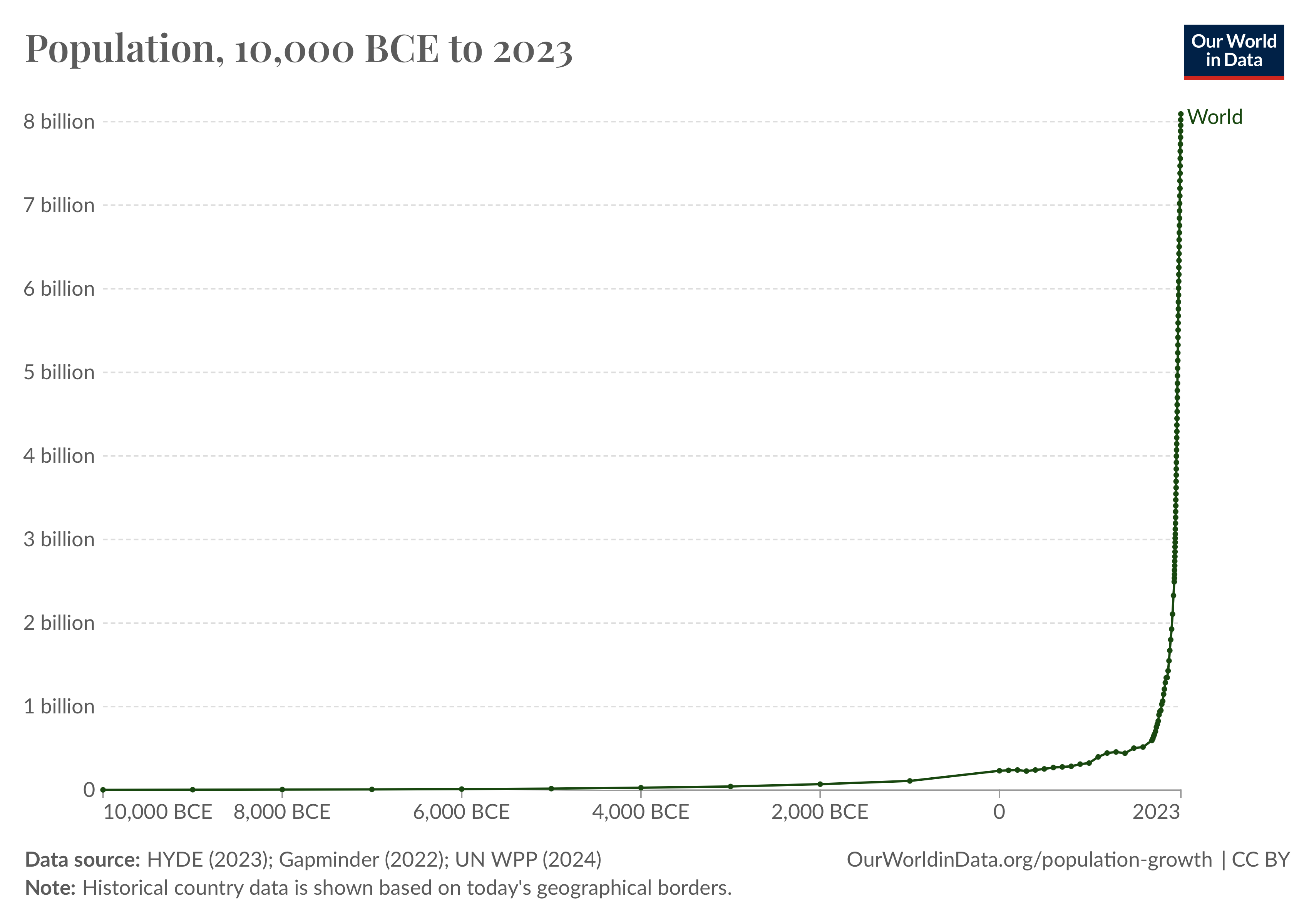
Taking this notable omission into my own hands, I decided to devote my allocated 12 speaker minutes at a Sustainable Land Management seminar with several hundred practitioners in the audience, to the well-known graphs of human population growth since the invention of agriculture.
Especially this one…
When the moderator called for questions, the silence seemed endless. I had shocked everyone mute, or perhaps dumb with incredulity.
After an eternity, someone asked if we should focus on actionable solutions or something equally banal. To this day, I am not sure what I expected.
The Forbidden Constraint
Eight billion people live on a planet that supported far less than one billion for most of recorded history and around ten million (that’s million with an m) before that.
For almost all of our evolutionary history, there were just 0.125% of today’s population, that’s one-eighth of one per cent of 8 billion.
The population explosion isn’t an abstract observation or a peripheral detail. It’s the central driver behind soil degradation, water scarcity, biodiversity collapse, and climate instability.
Yet academic papers, policy documents, and even AI chatbots systematically avoid the word “population,” preferring euphemisms such as “sustainable development” and “optimising resource allocation” in an astonishing collective denial.
We’ve elevated individual autonomy to such heights that questioning population growth registers as morally suspect, politically toxic, and professionally dangerous. The result is a global conversation about the environmental crisis that refuses to name the fundamental variable.
Meanwhile, the arithmetic asserts itself whether we acknowledge it or not.
The carrying capacity of Earth, that uncomfortable number that biologists calculate for every other species, doesn’t disappear for human populations because we’ve decided it’s too awkward to discuss. It shouldn’t be, but as this piece from the Insight Vault tells us, it is…

The taboo and the silence around it are odd, given that it’s a minor miracle that we made so many people without realising we had. Usually, we are quite chirpy about our achievements.
How We Hid the Numbers
For 290,000 years, humans lived within the same thermodynamic constraints as any large mammal. We competed for territory, followed game migrations, feasted occasionally on seasonal fruits, and often died when foraging and gathering failed.
The population rose and fell with resource availability, exactly as ecological theory predicts.
Then we discovered buried sunlight in the form of coal, oil, and natural gas. This one-time geological inheritance let us temporarily suspend the rules. The Haber-Bosch process alone, powered by natural gas, feeds nearly half of the eight billion people alive today. We burn 97 million barrels of oil daily to move food across continents, synthesise fertiliser, pump groundwater, and run the industrial base that underpins everything else.
The post-1950 population and industrial explosion, what researchers call the Great Acceleration, wasn’t the natural trajectory of human progress. It was an anomaly, a brief window when concentrated energy allowed the population to overshoot the carrying capacity without immediate collapse.
Today, we commandeer 50% of habitable land to feed ourselves and extract 170,000 terawatt-hours of energy annually, four-fifths of which come from fossil sources. This is ecological overshoot funded by a finite resource we’re depleting at an extraordinary speed.
Remove the fossil subsidy, and the actual carrying capacity becomes visible.
Estimates vary, but most ecological models suggest a pre-industrial baseline of between one and two billion humans living sustainably.
We’re currently maintaining four to eight times that number through energy-intensive agriculture, global supply chains, and the systematic conversion of every available ecosystem into human utility.
It is a considerable anomaly…

But surely we are smart and have fixed many challenges. We put men on the moon for goodness’ sake.
Why not sort all this out with technology?
The Technology Mirage
Walk into any technology conference, and the refrains are on a loop. Artificial intelligence will optimise resource use. Renewable energy will replace fossil fuels. Vertical farms and lab-grown meat will solve food security.
The underlying assumption is that human ingenuity, amplified by exponential technological growth, can transcend physical limits indefinitely.
This narrative is seductive because it’s partially true.
We have used innovation to temporarily raise Earth’s carrying capacity. But every solution creates new dependencies and demands even more energy. Vertical farms require vastly more electricity per calorie than traditional agriculture. Lab-grown meat consumes industrial quantities of resources to produce what pasture once provided with minimal inputs. Solar panels and batteries require rare-earth minerals extracted from ecologically fragile regions.
Technology doesn’t solve the constraint. At best, it buys some time, but each innovation adds another layer of dependence on the energy subsidy that makes the entire structure possible.
For example, when techno-optimists claim we’ve “decoupled” growth from resource use, they’re measuring efficiency gains while ignoring the continued rise in absolute consumption. In part thanks to the growing numbers and to Jevons paradox.
Here’s the thing.
We remain biological organisms on a finite planet, subject to the same thermodynamic constraints that govern every complex system. Maintaining what we have built requires continuous energy input.
Without it, entropy wins.

A human body burns 2,500 kilocalories daily to prevent decay. An economy of eight billion humans burns orders of magnitude more. The fossil fuel pulse lets us cheat temporarily, but the laws of physics do not negotiate permanent exemptions despite everything the tech bros preach.
The Modern Tragedy
Aristotle argued that a tragedy isn’t just “sad”; it is a machine designed to cleanse the audience’s emotions. In the story, the protagonist travels from happiness to misery. Unlike a comedy, which affirms that life will go on and society will survive, a tragedy confronts the painful reality that human beings are fragile and that our choices have irreversible consequences.
And here we are in a modern human tragedy.
What will clean out our emotions? It isn’t that we used fossil energy to build modern civilisation. Billions of humans exist because of that subsidy, and many will achieve great things. The tragedy is our systematic refusal to name the arithmetic of our situation, the one that came as a consequence of a one-time energy pulse that Aristotle couldn’t possibly see coming.
We are here, 8 billion and counting. We need to see this painful reality.
Academic discourse dances around population with abstractions like “consumption patterns” and “distribution challenges,” as if rearranging deck chairs addresses the fundamental constraint.
Policy documents propose efficiency measures while ignoring that cheaper resources get used more, not less. Economists promise indefinite growth on a planet where every major ecosystem is already in decline.
Technology buys time, not escape and pretends that carrying capacity is a value judgement or a political position.
And through all the pretending, we cling to the assumption that...

Relevance to Mindful Scepticism
Mindful scepticism means asking the question that is usually met with uncomfortable silence.
How many people can Earth support without the fossil fuel subsidy?
This clarity doesn’t promise comfort or easy answers. But it offers the intellectual honesty to face our situation without the delusion that we’re somehow exempt from the constraints that govern every other complex system on Earth.
A mindful sceptic loves a good tragedy and is always up for some uncomfortable arithmetic.
With some curiosity, critical thinking, and evidence, it is possible to distinguish between genuine solutions and elaborate mechanisms for shifting consequences.
Mindful scepticism questions whether eight billion humans, heading toward ten billion, can persist within Earth’s actual carrying capacity once the one-time energy subsidy runs out.
Most importantly, it allows us to recognise that we’re not exempt from density-dependent constraints, thermodynamic limits, or ecological overshoot.
Every other species faces these boundaries. We’ve temporarily masked them with concentrated fossil energy.
That reprieve is ending.
Mindful Momentum
Track the silence... Over the next month, review five major reports on sustainability, climate policy, or environmental strategy. Count how many times population appears as a central variable versus how often you see abstractions like “consumption patterns,” “efficiency,” or “equity.” Document the linguistic gymnastics used to avoid stating the number directly.
Calculate local carrying capacity... Research how many people your region could support using only local renewable resources of food, water, energy, and materials. Compare that number to the current population and projected population growth. Identify which percentage of the current population depends entirely on fossil-fuelled supply chains and energy-intensive agriculture. Here is a hint… the UK imports nearly half the food needed to feed its population.
Ask the forbidden question… The next time you’re in a conversation about environmental solutions or sustainability, pose this directly… “How many people could this system support without fossil fuel subsidies?” Observe not just the answer, but the silence, discomfort, or deflection that precedes it. Notice whether responses focus on technical optimisation rather than acknowledging the fundamental constraint.
Key Points
Earth’s human population has increased by eight times its historical carrying capacity, supported entirely by a one-time fossil fuel subsidy that temporarily suspended ecological constraints.
Population growth is systematically omitted from academic, policy, and environmental discourse through linguistic avoidance, treating human numbers as too sensitive to examine directly.
Technology postpones rather than solves resource limits, creating dependencies, increasing system complexity, and requiring continuous energy inputs that ultimately intensify the constraint.
Mindful scepticism requires naming the arithmetic that mainstream discourse avoids: current human numbers exceed planetary carrying capacity, and the energy subsidy masking that reality is finite.
Curiosity Corner
When we examine population growth and its limits through a mindful sceptic’s lens, here are some better questions worth asking…
Why does environmental policy focus on per-capita efficiency while treating the total population as an immutable given?
What changed between 1800 and today that allowed the population to increase from one billion to eight billion, and is that change permanent or temporary?
If carrying capacity applies to every other large mammal, what evidence suggests humans have permanently transcended those constraints rather than temporarily masked them?
How do we maintain collective belief in indefinite population growth on a planet where multiple ecological boundaries have already been crossed?
What becomes possible if we name the constraint directly, and what remains impossible if we refuse?
In the Next Issue
Next time, we’ll walk the paddock at first light and listen for the low hum of bees along the creek, a sign the land is mending itself before anyone measures the yield of the crop. This is us taking a closer look at regeneration.
What happens when a farmer chooses roots over revenue, and whether resilience is a long game or wishful accounting.
Today is January 1st. In roughly 6 months we will be hitting Earth overshoot day, again!
The conundrum I have been pondering for years is how do we reduce the human population in an ethical manner? I have not yet figured that out, but I do know that a correction will take place relativelysoon, and it won't be pleasant.
Perhaps meant was not the best choice of words. Meant as in "supposed to". To be more specific, 2 speicies (humans and viruses) who evolved together creating a symbiotic environment. Viruses keep human numbers where they are sustainable for their ecosystem, human survivors would be those that have the best immune system and environment, and animals give viruses a host and transportation. Vaccines unbalanced the relationship. You could make a similar argument with antibiotics. Both have extended billions of lives, mine included. Also an atheist who thinks the ship is long gone as well.