



I make rice dishes with Basmati rice and the absorption method. Wash the rice well, dry it in the pan until all the grains separate, flavour as required, then add two cups of water for each cup of rice minus a little. Find a well-fitting lid and cook on low heat for 10 to 12 minutes, and a fluffy outcome is almost guaranteed. Biryani, stir-fries, and special fried rice were always meant to exist this way.
Outside the kitchen, somewhere else, someone else is growing the next crop. Because the world eats rice all the time.
The Hard Number
Modern rice is a story about continuous global throughput constrained by land, water, energy, and milling capacity.
The latest USDA and FAO data put annual global consumption at approximately
544 million metric tons of milled rice.
This one staple supplies about 17–20% of the total calories consumed by the global population, feeding over 3.5 billion people daily.
Framing the hard number
Millions of tons are impossible to visualise.
Let’s try one metric ton (1,000 kg) of rice, and it helps to switch from weight to space and packaging, to make the visuals easier. One metric ton would be a little over 1 cubic metre (40 cubic feet.) A standard built-in dishwasher is roughly 8 cubic feet. If you were to stack five dishwashers in a neat 2x2 pile with one on top, you would be looking at the volume of one measurement ton.
In the global market, rice is most commonly transported in 50 kg (110 lb) sacks, so a ton is 20 sacks, which, on a standard wooden shipping pallet, 20 sacks would stand about chest-high for an average adult.
If you tried to count every grain in that one-ton pile, you would get to roughly 50 million individual grains of rice.
A ton of rice is an enormous amount of food in human terms that can provide the main daily caloric intake for roughly 5,500 people for one day, or feed a family of four for about 3 to 4 years if rice is their primary staple.
Behind the hard number
Some basic rice.
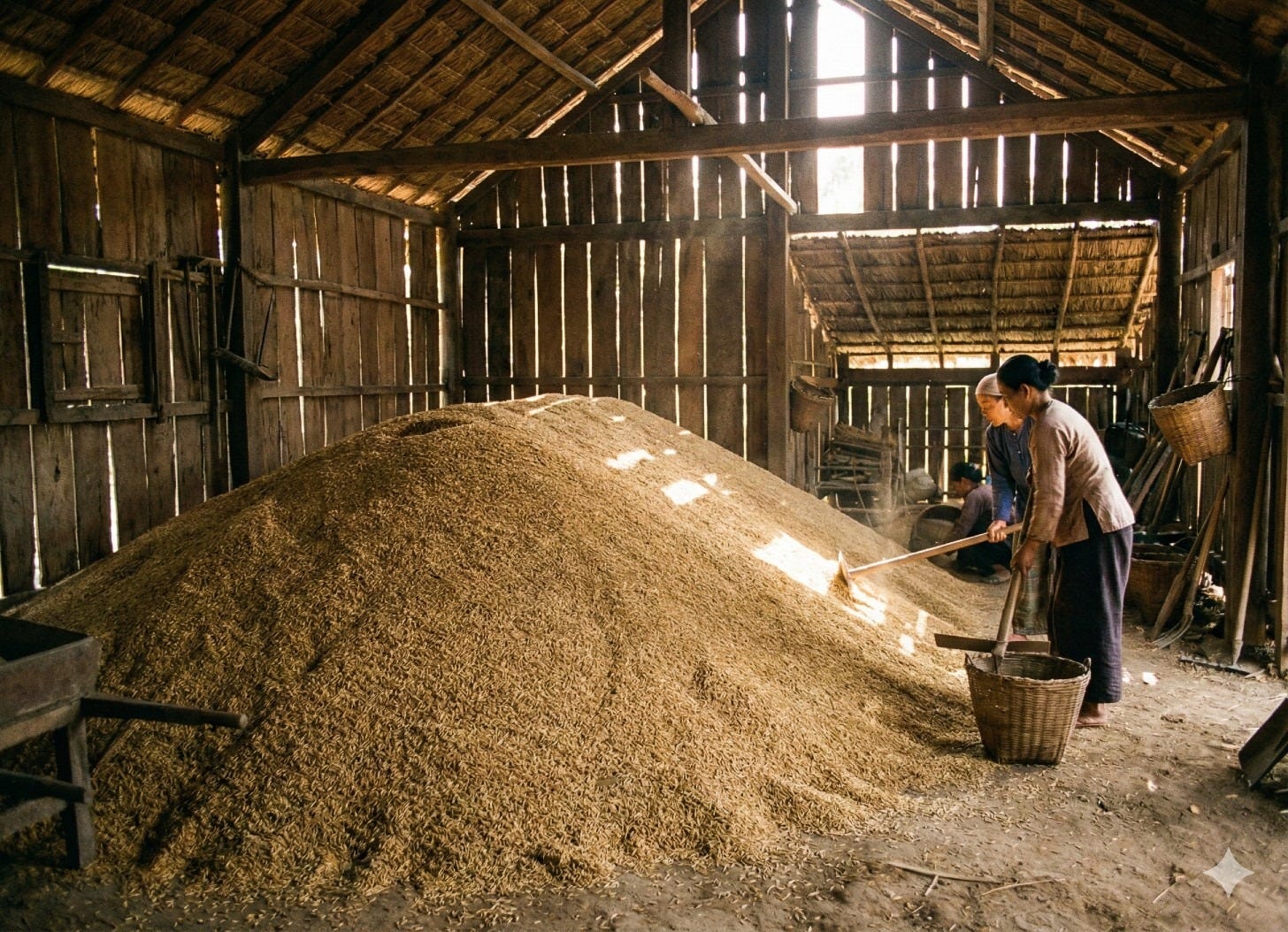
Rice arrives in your kitchen as milled rice, but it is grown and harvested as paddy (rough rice), which is then processed. During processing, rice loses about 30 per cent of its weight, depending on recovery rates and equipment.
That detail matters because global consumption is reported on a milled basis, while yields and farm realities often start on a paddy basis. A typical global standard milling recovery is roughly 70 per cent, with modern multi-stage mills around 65 per cent and traditional village mills as low as 50 to 55 per cent.
So the causal chain looks like this.
People demand milled rice for food, but milled rice depends on a paddy harvest, and that harvest depends on land, water, labour, fertiliser, machinery, and timing; then milling adds its own dependencies of energy, equipment, and quality control.
The big challenge with 544 million metric tons of milled rice is that this is far too much to store for any length of time. In small batches, like the bag in your pantry, it will keep for a year or more so long as oxygen, moisture, light, and pests are constrained. But millions of tons is a civil engineering problem.
The dominant structure is the vertical steel or concrete silo, with a single large unit holding between 10,000 and 20,000 tons. The central technical challenge is temperature. A single hot spot in a large silo triggers mould or spontaneous combustion, so computer-controlled aeration systems push air through perforated floors to keep the mass uniform. In tropical climates, grain chillers drop temperatures to around 15 degrees Celsius, putting insects into a biological coma. For long-term national stockpiles, nitrogen injection at 99 percent concentration replaces the atmosphere entirely, killing all pests without chemical residue. Traditional bag storage without climate control loses between ten and fifteen percent to rodents and spoilage. Modern industrial storage holds annual losses below one percent, assuming that infrastructure exists.
Some rice can be stored for a time, although not very effectively in the traditional shed, but you cannot store your way out of a system that needs to deliver roughly 1.5 million tons every day.
That level of throughput means we have to grow it.
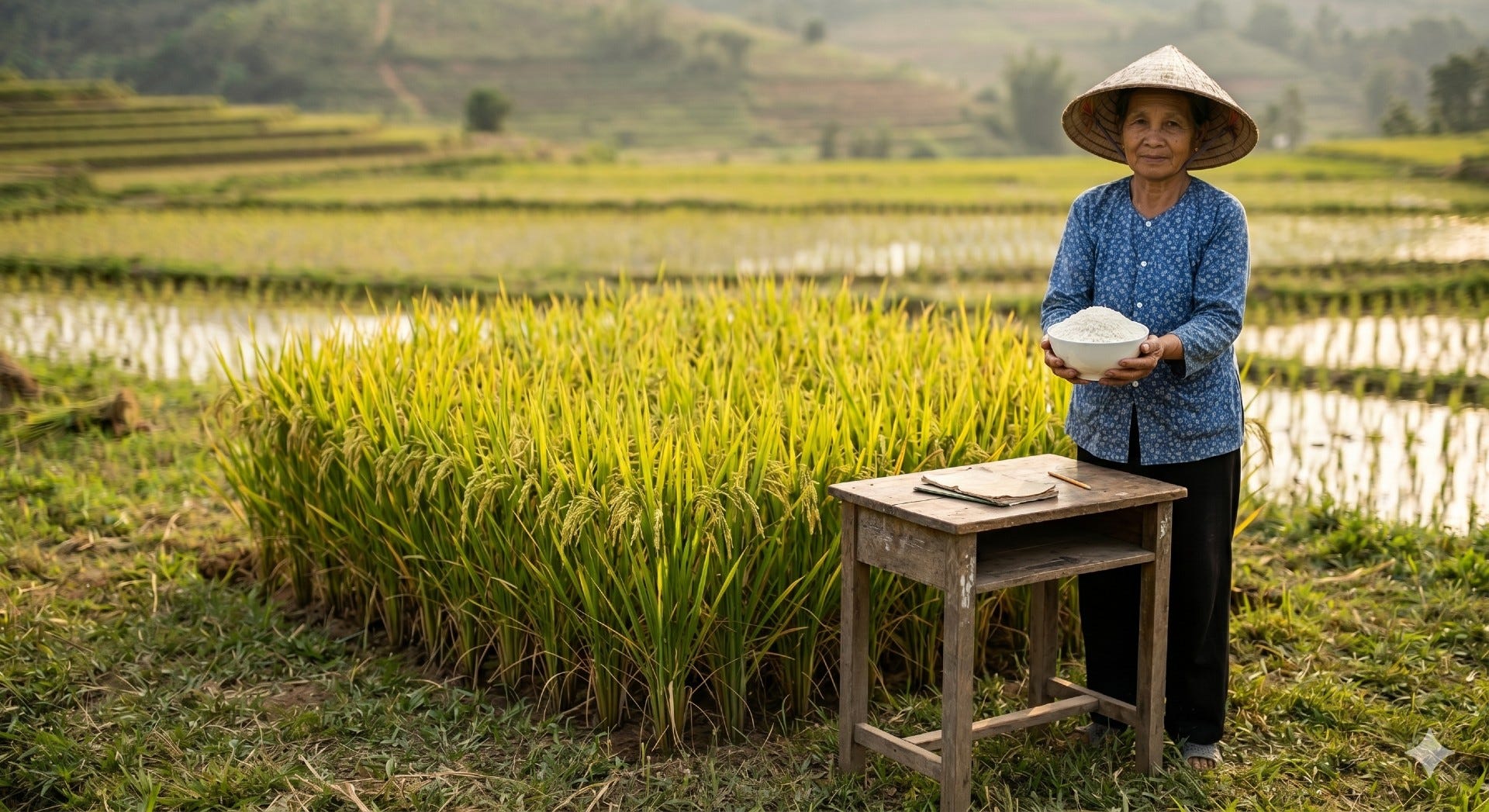
Assuming a paddy yield of 5 tons per hectare and a milling recovery rate of 70 per cent, feeding the world’s rice appetite for one day would require harvesting roughly 426,600 hectares, the area of Rhode Island or Dubai.
Two things to notice.
Rice, like most staple foods, is primarily a throughput story. This means it is not really about how much land rice uses in the abstract, but how much land-equivalent must perform successfully today and tomorrow. The scale is also fragile because it rests on a stack of assumptions, and small shifts in those assumptions move the result a long way.
If yields are around 10 t/ha as a plausible upper benchmark, the land required for a day roughly halves to about 213,000 hectares; if yields are around 2.2 t/ha as a plausible lower benchmark, it jumps to about 970,000 hectares; and if milling recovery drops to 55 per cent, the hectares required rise even if field yield stays the same.
Most public narratives skip these assumptions. Food security is often framed as a seasonal production challenge, but rice behaves more like a daily systems-performance requirement, where weak links show up fast.
The Deeper Pattern
Rice is a food staple, and there are two stories people like to tell about staples.
One is the progress story where yields go up, technology improves, markets smooth volatility, and everyone gets fed.
The other is the moral story. If there is hunger, someone is hoarding; if there is greed, someone is failing ethically.
Both stories dodge the throughput constraint.
The system has to keep converting water, land, nutrients, and energy into edible calories at scale. That conversion can be buffered a little, but it cannot be paused. You can be ahead of the curve for a season. You cannot be ahead of the curve forever.
That is why the institutional theatre is so persistent.
Institutions prefer numbers that are legible, flattering, and easy to repeat. If there are 185 million tons of rice stocks, it sounds like control. Record yields sound like inevitability. The manual calls this measurement hygiene. Without clear boundaries, denominators, and source provenance, numbers become comfort objects.
And there is a second incentive layer.
Rice demand growth is shifting, with Sub-Saharan Africa often identified as the fastest-growing demand region and potentially contributing around 27 per cent of global consumption growth over the next decade.
That makes this a policy and infrastructure story as much an agronomy story about import dependence, milling and storage investment, port capacity, logistics, and foreign-exchange constraints can matter as much as seed varieties. The comforting institutional habit is to compress a complex system into one lever, usually yield, and one reassurance, usually stocks because that is repeatable and meeting-friendly, but it is a poor guide.
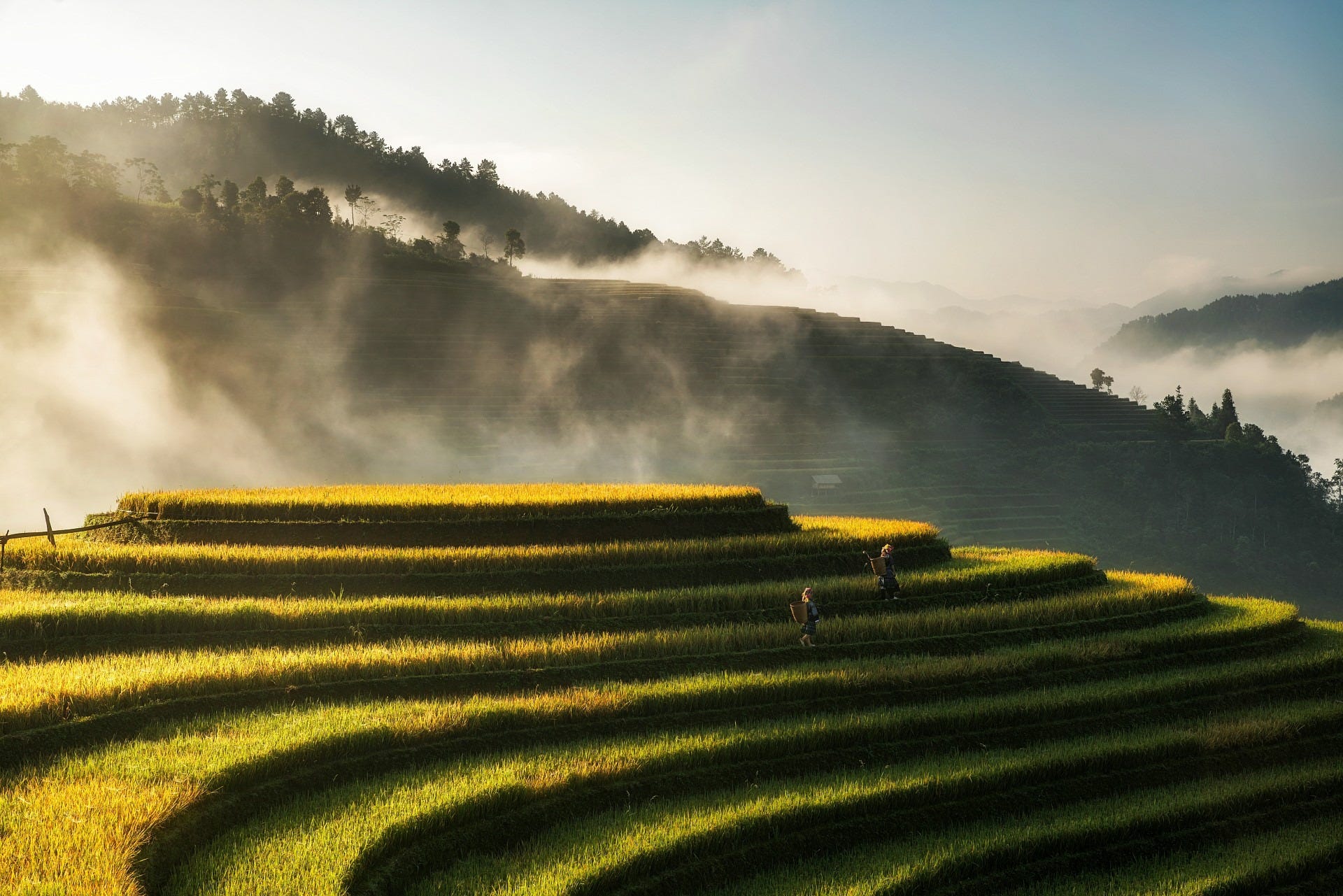
Rice yield is not simply biology; it is water control, land preparation, fertiliser, diesel and pumping, reliable milling power, transport capacity, and an increasingly climate-shaped risk profile that can break any link in the chain.
Being a Mindful Sceptic
A mindful sceptic uses curiosity and critical thinking to rigorously question ideas and demand evidence, while being aware of what matters, when it matters, and how to avoid the trap of cynicism.
Three mindful sceptic moves are worth making with the rice number.
Convert annual to daily. Any food security claim anchored to annual production or stock figures is hiding the throughput reality. Ask what must be true today, not what looked good in last season’s harvest report. The hectares-per-day frame is a useful diagnostic precisely because it is uncomfortable.
Follow the conversion losses. Milling recovery is where the same field output becomes a different edible supply depending on equipment, power, and quality control. A yield improvement running through a 50% village mill is not the same as one running through a modern 70% facility. That distinction rarely appears in the headline number.
Treat buffers as institutional, not physical. A stockpile is only a buffer if it is accessible under stress, in the right form, at the right place and time. Who holds it and under what release rules matters as much as the tonnage figure.
For any rice statistic you encounter, including those above, apply the same test. State the value, unit, year, geography, denominator, system boundary, and source. If you cannot fill those fields, downgrade the claim.
Key Points
Rice is a daily throughput system, not just a food category. With global milled-rice consumption on the order of ~544 million tonnes per year in 2025, even one day of rice requires an enormous amount of successfully functioning land and logistics.
Yield is inseparable from infrastructure because milling recovery is a conversion bottleneck, meaning the same field output can translate into very different edible supply depending on milling equipment, power, maintenance, and quality control.
Buffers are political, and so are the numbers. Large stockpiles don’t automatically equal resilience if they are held domestically and released according to national priorities
Institutions prefer repeatable, flattering metrics, so a mindful sceptic converts annual claims into daily requirements and applies measurement hygiene before treating any headline number as load-bearing.
Back to the Front
The biryani is ready and delicious; a small domestic event.
But rice is not small. It is the visible end of a process that has to succeed again tomorrow, and once more the day after that, on land, water, and energy; we do not get to renegotiate.