


TL;DR
The fossil-fuelled expansion that powered unprecedented economic and population growth is waning, revealing the zero-sum dynamics temporarily masked by abundant energy and technological innovation. Climate destabilisation, soil degradation, and biodiversity collapse aren’t separate crises but interconnected symptoms of a civilisation exceeding planetary boundaries. As these constraints tighten, the question isn’t whether we’ll play a zero-sum game but how. Through historical examples and potential models for equitable distribution, it is time we examined how different approaches to resource allocation might function when increasing the size of the economic pie is no longer possible.
I live in the Blue Mountains west of Sydney, Australia in the federal electorate of Macquarie, named in honour of Major-General Lachlan Macquarie, who was Governor of the Colony of New South Wales for 11 years from 1810. At the time of writing, around 100,000 voters live in the electorate, and we all went to the polling booths on 3 May 2025, as required by the compulsory voting system in Australia, to cast a vote for our preferred candidate.
It turned out to be a historic event. The Labor Party was returned to government in a landslide victory, massively repudiating the populist nonsense that had been trying hard to take over Australian politics.
The Australian parliamentary system is tightly constrained in that there are a fixed number of seats in each legislative body. This always means a gain in representation for one party or group means a corresponding loss for another. All elections in single-member districts are like this. One candidate’s gain in votes and a seat in the parliament or assembly directly subtracts from the chances of others, and there’s no possibility for mutual gain. This structural setup encourages zero-sum thinking in political competition, often intensifying partisanship and conflict over influence.
I win, you lose generates more vitriol than debate.
I can’t discuss your position in case it is perceived as a weakness on my part. And you likewise. If we both recognise that the subject requires compromise for the mutual benefit of constituents, there is no apparent benefit to my moving forward. So I either ignore the subject and throw random piles of manure at you or immediately change the topic to something I believe gives me a better chance of winning.
Ah, the joy of a zero-sum game.

Politics is one way that humans organise themselves around a social contract. We consent, either explicitly or implicitly, to surrender some personal freedoms in exchange for the protection and order provided by a governing authority. Without government, as philosopher Thomas Hobbes described it in the 1600s, life would be chaotic and insecure in the state of nature. To escape this condition, individuals collectively agree to establish rules and a central authority to enforce them, thereby gaining security and predictability.
A century later, John Locke viewed the social contract as an agreement to protect natural rights of life, liberty, and property, arguing that governments derive legitimacy from the consent of the governed and must be held accountable to the people. Then in the 1700s, Jean-Jacques Rousseau, emphasised the general will and collective sovereignty, suggesting that legitimate political authority arises not from rulers imposing order but from citizens actively shaping the laws they follow.
All this means that there has been citizen agency in politics for a long time. We have governments because we permit them to exist based on shifting sets of promises, loosely the social contract.
In a modern democracy, the social contract is the deal we all live under. You give up some freedom, and you get the benefits of organised society, including security, justice, and prosperity. That bargain has teeth, which is why we accept laws that limit how any one person can exploit land, water, air, or biodiversity.
The mechanism is simple. Unchecked individual use can degrade the shared asset and leave everyone worse off. That is why you end up with rules on water extraction or carbon emissions. It is a collective response to a predictable mode of failure.
Governments, as agents of that contract, are given the authority to allocate and manage resources. They set limits, issue permits, enforce environmental protections, and decide how to trade off economic development against ecological sustainability. In the ideal case, those decisions are shaped by public participation and reflect what Rousseau called the general will, so resource use tracks broadly held values and long-term interests rather than short-term individual gain. That is what public interest is supposed to mean.
When the contract is perceived as broken, either through corruption, inequality, or repression, it can lead to civil unrest or calls for reform.
Legitimacy frays when resource decisions start to look like a rigged bargain. When outcomes feel like environmental degradation, corporate exploitation, or a state that cannot, or will not, address climate change, the public stops seeing trade-offs and starts seeing favouritism. Legitimacy can fail altogether if people perceive too much short-term individual gain for a privileged few.
That is when citizens push back. They ask for transparency, for a distribution that feels fair, and for environmental stewardship with real teeth. A lot of the tension in the U.S. sits right there, in whether the system still serves the many.
And this is the uncomfortable part. The social contract is not a static document. It is renegotiated in real time as societies argue over justice, responsibility, and the common good while drawing down finite, interdependent resources.

So, what happens in resource allocation when it is all or nothing?
Zero-sum resource scenarios, where one individual or group’s gain inevitably means another individual or group’s loss, are common in the raw state of nature. In a closed environment, there is a finite amount of solar energy and nitrogen. While different species can cooperate to use those resources efficiently, they cannot create more energy out of thin air. In that macro sense, for one population to explode in size, another must eventually contract, or the environment will degrade. You might recognise this as the zero-sum ceiling, called Carrying Capacity (K).
In humans, who think themselves beyond normal laws, the social contract exists precisely to transform these high-conflict, zero-sum dynamics into regulated, negotiated arrangements that can foster social stability and equity. Instead of leaving resource outcomes to power struggles or pure competition, societies use the social contract to justify the institutions of laws, policies, and enforcement mechanisms that coordinate and constrain behaviour for shared benefit. This can include public ownership, redistribution mechanisms, environmental regulation, or property rights systems.
I might own the land, but it doesn’t mean I can cut down all the trees or pollute the river at the bottom of the paddock.
Importantly, the social contract doesn’t assume every resource decision is a knife fight. It’s the opposite. It’s the framework that lets societies turn cooperation, innovation, and stewardship into positive-sum outcomes.
Take a river. In a functioning system, you can manage it to preserve ecosystems, supply drinking water, support agriculture, and respect Indigenous rights. That package deal is far less likely when everyone is sprinting for first access.
The same logic scales. Through agreements like the Paris Climate Accord, nations can shift away from a destructive scramble for carbon-based development and towards coordinated emissions reduction and renewable energy innovation. The point is not moral virtue. It’s that collaboration can expand the set of outcomes that work for everyone.
Nonetheless, zero-sum thinking hangs around, especially when resources are tight or when the benefits and burdens land unevenly. And here, the social contract brings transparent negotiation, inclusive governance, and rules that can adapt as conditions change. Without those, legitimacy drains away because people can’t see the logic or trust the trade-offs.
So yes, the social contract may begin in conflict over finite goods. But its ambition is to coordinate and use social agreement to stop every decision devolving into a scramble.
What all this means is that there is a natural conflict between those who like the zero-sum of winners and losers because they fancy themselves as perpetual winners and the social contract that, even though it can and does create zero-sum scenarios, is an efficient way to constrain such behaviour and increase the chance of mutual benefit. Crudely, this is the right and left of Western politics.
But what if the social contract also masks the inevitable conflicts over resource distribution and allocation? Here’s looking at you, imperialism.
And, belatedly, here is the first premise for rethinking equity…
Resources are uneven in volume, quality, and access, but since the Industrial Revolution, historical economic growth has masked conflicts over resource distribution and allocation
The Industrial Revolution ran on fossil energy, and it changed the growth curve. Mechanisation and technological innovation turned energy into throughput, and throughput into sustained economic and population growth. For many societies, especially in the Global North, that translated into more goods, more services, and rising living standards.
But the dividends were never evenly shared. Resource endowments stayed unequal across regions, and the benefits of industrialisation flowed disproportionately to those with political power, access to capital, and control over production infrastructure. That is how you get growth on paper alongside entrenched advantage in practice.
Developing regions were often pulled into the system as raw-material suppliers on exploitative terms, and those terms became structure. Global trade scaled up, but the inequality was baked in.
Pandore is a Belgian political TV thriller that delves into the complexities of justice, power, and personal integrity, following a judge whose investigation into corruption uncovers unsettling truths about her own family. Many scenes occur in the buildings and public spaces of Brussels, resplendent with its 19th-century architecture, notably the Palais de Justice, commissioned by King Leopold II and completed in 1883 imposing neoclassical architecture, characterised by a colossal dome, grand staircases, vast halls, and classical columns. The building was designed to convey the power and modernity of the Belgian state.
It certainly is grand. It was paid for with ivory and rubber extracted from what is now the Democratic Republic of the Congo (DRC), a land of 2.34 million square kilometres (905,000 sq miles) in Central Africa, roughly 77 times larger than Belgium. Extraction quotas were brutally enforced by Leopold’s private army, the Force Publique.
But I digress.
Periods of high economic growth, however funded, have historically acted as a kind of economic analgesic, dulling public awareness of underlying distributional injustices. The sheer expansion of wealth allowed many conflicts over access and equity to be postponed, externalised, or absorbed.
This has often occurred through increasing debt, exploiting natural resources, or relying on geopolitical dominance. For example, post-war growth in Western nations in the 20th century supported welfare state expansion without fully confronting wealth inequality, environmental costs, or the extractive foundations of that growth in formerly colonised regions.
The masking function of growth has weakened over time. Environmental degradation, climate change, and social unrest have brought renewed attention to the sustainability and inequity of historical resource allocation and use. The global economy’s reliance on continuous growth is increasingly scrutinised, especially as finite resource limits and planetary boundaries challenge the assumption that growth can indefinitely substitute for equity. Trickle down has had its day.
The premise highlights the central tension now facing the social contract. Can future prosperity be decoupled from both ecological harm and entrenched inequality?
Presumably, it cannot be under the existing political systems in the Global North, which assume both I win, you lose and that growth can continue indefinitely.
Hence…
The arrival of a zero-sum resource allocation creates fundamentally different political dynamics
In a positive-sum environment, real or imagined, where economic growth expands the pool of available resources, political systems often function through compromises that distribute gains without zeroing out others’ shares. This allows for coalitions, bargaining, and policies that simultaneously placate, to a degree, multiple interests.
However, when growth slows or environmental limits are reached, societies shift toward zero-sum dynamics where one group’s gain is perceived as another’s loss. This has profound implications for political stability and institutional trust, as the conciliatory politics of expansion give way to distributive struggles marked by scarcity, resentment, and protectionism. Arguably, this is precisely the scene played out in the second term of President Trump.
Zero-sum stories are political jet fuel. They give populist, nationalist, and authoritarian actors an easy story that politics is a survival contest over jobs, land, water, energy and someone is coming to take yours.
Once that frame holds, narratives tighten. Appeals to ethnic, national, or class identity become the justification for exclusion and unequal claims. The argument stops being about growing the pie and becomes a fight over who deserves which slice, with old grievances revived on cue and incumbent elites quietly protected.
You can see the pattern in today’s stress points. Climate-related migration, access to arable land, and control over carbon budgets all trigger the same reflex to treat cooperation as weakness and compromise as loss. Under that psychology, international coordination doesn’t fail because it is impossible. It fails because it is politically costly to admit the game isn’t zero-sum.
Tariffs fit neatly inside a zero-sum frame. In theory, you tax imports to reduce reliance on foreign goods, boost domestic production, and protect local jobs. The implied premise is that trade gains are not mutual. They flow to exporters, while importers lose. Under that logic, every import is a leaked opportunity at home, a direct subtraction from domestic capacity.
And the strain doesn’t stop at trade policy. Institutions designed around presumed growth, notably the pensions and welfare systems of liberal democracies, often struggle when the baseline shifts. Their legitimacy depends on delivering rising living standards, or at least preventing decline. In a world constrained by planetary boundaries, that promise gets harder to keep. When distribution becomes the central problem under constraint, the system can tilt toward more coercive or hierarchical governance just to hold together.
In democratic systems, political parties, interest groups, and social movements compete to protect their constituencies’ access to diminishing resources, making consensus difficult and sometimes leading to policy paralysis. Arguably, this has been the fate of the UK Labour government elected in a landslide in 2024.
A more specific example is the United States’ handling of water scarcity in the American West. The Colorado River Basin still runs on the century-old Colorado River Compact, built on flow data from an unusually wet stretch that encouraged over-allocation. That misread baked in a structural deficit, now squeezed harder by mega drought conditions and climate change. As Lake Mead and Lake Powell dropped toward critical levels, the fight between agricultural users, fast-growing cities, and Indigenous nations stopped being a local courtroom sport and became a federal problem. Tribes with senior water rights, ignored for decades, have increasingly pushed their sovereignty to the front, insisting on a real seat at the table with governors and federal officials.
What has followed is cooperation of a kind the region rarely manages, and it still feels fragile. In 2023 and 2024, the Lower Basin states (Arizona, California, and Nevada) reached a landmark deal to cut water use in exchange for federal funding through the Inflation Reduction Act. The immediate purpose was to stabilise reservoir levels and avoid dead pool scenarios where water can’t move through hydroelectric dams. The relief is real, but it is temporary through 2026. The deeper consequence is legal and cultural, a slow pivot away from ‘first in time, first in right’ toward a more flexible, conservation-based model that treats the river as finite and shared, rather than an endless commodity.
Europe’s energy transition shows a different version of the same stress. The European Green Deal sets the banner goal of climate neutrality by 2050. But the carbon pricing and the winding back of fossil fuel subsidies that underpin it lands the hardest on rural and low-income people, who don’t have the infrastructure or the spare capital to jump to electric vehicles or heat pumps.
France gave the clearest early warning. In 2018, the proposal to raise the carbon tax on diesel hit a fuel many rural commuters are forced to rely on, and it became the spark for the Gilets Jaunes (Yellow Vests) movement. The uprising became a rejection of transition-by-price-shock, where long-term environmental outcomes are pursued without immediate, equitable safety nets for those most exposed to volatility.
That backlash has changed how European climate policy is built and sold. Once a transition is perceived as elitist, it stops being a technical pathway and becomes a political instability machine. The European Union’s response was to bolt redistribution into the policy architecture through the Social Climate Fund and the Just Transition Mechanism, explicitly routing carbon revenues back toward vulnerable households and supporting regions dependent on carbon-intensive industries. France, meanwhile, pivoted toward green leasing for low-cost electric vehicles and expanded subsidies for home insulation.
The European lesson is unromantic. The success of the energy transition hinges less on technical feasibility than on social legitimacy. And legitimacy, in this context, is earned through wealth redistribution and socio-economic equity, not slogans.
China’s approach sits at the other end of the governance spectrum, with national priorities first, local autonomy and public debate a distant second. The South–North Water Transfer Project, one of the largest engineering feats in human history, was built to correct a basic geographic mismatch of a water-rich south, and a water-poor industrial north. And unlike democratic systems that grind forward through litigation, hearings, and public comment, the Chinese state used centralised authority to imposed strict water quotas. It forcibly relocated hundreds of thousands of villagers to clear space for canals and reservoirs. This was command and control governance as fast execution, engineering efficiency, and a working assumption that environmental and social costs are manageable externalities in service of long-term national water security.
The result is effective, and still contentious. Water supply has been stabilised for the North China Plain and for Beijing. The project now diverts billions of cubic meters annually, slowing the dangerous drawdown of northern aquifers and keeping industrial growth on track. But the technical win carries large-scale social and ecological displacement.
In food crises or fuel shortages, authoritarian states may reach for rationing, price controls, or direct monopolisation of resource flows. Sometimes that delivers short-term order, including guaranteed access for elites while others are impoverished. These regimes can look more responsive or decisive, but the trade-off is long-term instability if repression fails to contain discontent, or if legitimacy is propped up by economic promises that cannot be sustained.
Yet, the distinction isn’t absolute.
In both systems, legitimacy erodes when resource allocation reads as unfair or simply incompetent. Sri Lanka’s 2022 collapse came from mismanaged agricultural policies and fuel shortages that helped trigger a crisis in which a nominally democratic government drifted toward authoritarian controls, then met mass protests.
The counterexample is what some democracies do when they treat scarcity as a coordination problem rather than a policing problem. Participatory budgeting and citizen assemblies, such as Ireland’s climate assembly, create a forum to negotiate shared sacrifices and allocate constrained resources in a way people can see as procedurally fair.
Taken together, the lesson is not that authoritarianism works or that it can look more decisive under pressure. But democratic resilience comes from adaptability, and from the ability to build inclusive responses to scarcity that preserve consent while making hard choices.
The arrival and prospect of resource constraints explain much of recent geopolitics and the rise of populism in the Global North. When scarcity rears its ugly head, doubling down to be the winner is as human as helping the blind man cross the road.
However, this is not new. Humanity has faced scarcity many times, as many humans do daily. This means that there are options and templates other than the capitalism of high-income democracies.
Various societies have developed different approaches to managing scarcity.
Societies have responded to scarcity in diverse ways, ranging from communal stewardship to hierarchical control, depending on their historical context and environmental constraints.
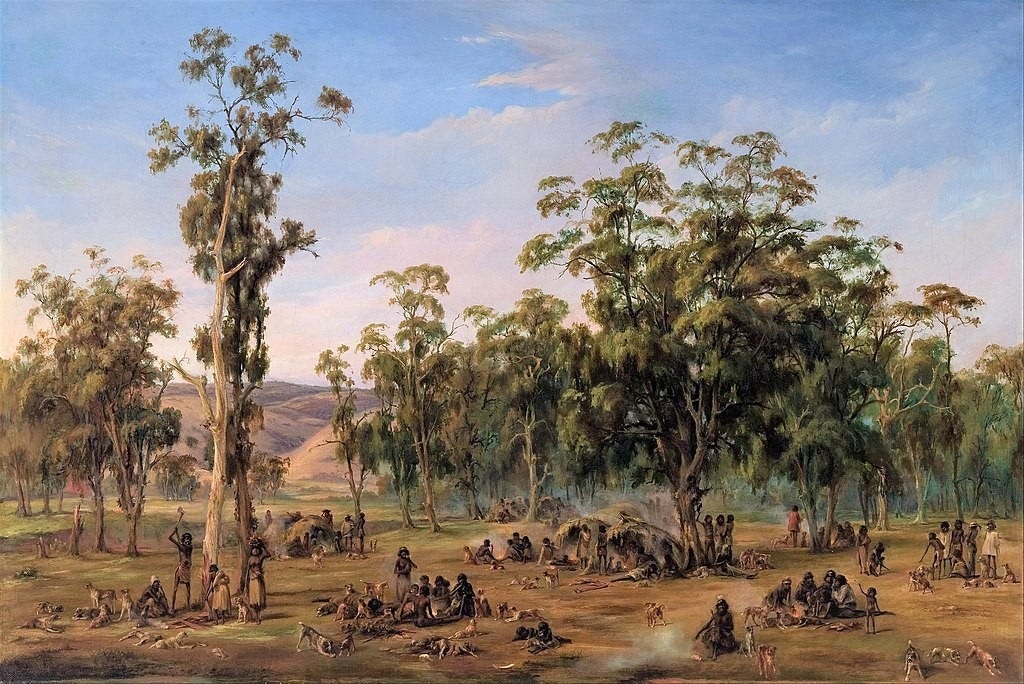
For example, Indigenous societies in arid regions, such as the Australian Aboriginal nations or the Pueblo peoples of the American Southwest, developed intricate land-use practices and spiritual frameworks that emphasised moderation, reciprocity, and intergenerational responsibility. These norms were often encoded in oral traditions and rituals, reinforcing sustainable relationships with finite water and food supplies.
The frame is different as there is no external energy beyond the power of fire. Everyone knows there is a limit and so various forms of sharing make good sense. Scarcity, in this context, was managed not only through practical techniques like seasonal rotation but through a culture that framed restraint as moral and communal.
In contrast, agrarian empires such as Ancient Egypt or imperial China managed scarcity through centralised bureaucratic systems. These regimes invested in large-scale irrigation systems, granaries, and taxation mechanisms that enabled surpluses to be stored and redistributed during droughts or famines. Here, scarcity management was institutionalised through state power, where administrative foresight and social hierarchy determined who bore the burdens of scarcity. Similarly, medieval European societies employed feudal systems and ecclesiastical authority to enforce moral and material norms related to scarcity through tithing, land tenure, and charity, often mediated by religious obligations.
Here there was some modest extra energy from crops and livestock, so long as everyone put labour in to ensure that agriculture was an energy source.

In modern capitalist societies, scarcity is usually expressed through the market as price signals and purchasing power. Access is resolved by who can pay, and the system can be efficient in some cases because it coordinates demand, supply, and substitution with relatively little explicit negotiation.
But that same design also hardens inequality. If scarcity is mediated by buying, then the wealthy don’t experience scarcity in the same way. They can buffer it, sometimes almost completely, through private access to water, food, or energy. Scarcity still exists, it just shows up elsewhere, and often for someone else.
Some countries have tried to blunt that dynamic with hybrid arrangements. The Netherlands and Singapore are examples of models that mix market tools with strong state planning and technological innovation. The point is not to abolish price signals, but to keep scarcity from becoming a pure bidding war by committing to long-term infrastructure investment and building social consensus around how land, water, and energy are managed.
Other regions follow a different logic. In parts of sub-Saharan Africa, customary tenure systems have been maintained or adapted alongside state institutions. That creates a layered governance structure with traditional authority operating in parallel with formal legal frameworks, and the balance negotiated rather than assumed.
The premise points to a core insight from political ecology and comparative anthropology. Scarcity is not just a material condition. It is also a social interpretation and a governance problem. How scarcity is perceived, organised, and responded to can vary dramatically across societies, even when the underlying constraints look similar.
And those responses are never purely functional. They express what counts as legitimate authority, what fairness means, who is owed protection, and what kinds of trade-offs are acceptable. More often than not, the zero-sum game is anticipated. And mechanisms are invented, refined, and deployed to manage it before it becomes a full-blown scramble.
One approach that has been around a long time is the commons, and it is worth its own premise…
Commons-based approaches offer potential alternatives to market/state binaries
Markets allocate resources through price signals and competition, while states distribute resources through planning and regulation. Hence, the establishment of ideology reflecting the state and the individual, broadly characterised by the left and the right, that dominates liberal democracies. However, this binary overlooks a long-standing and globally diverse category of resource management known as the commons.
Commons-based approaches involve communities collectively managing shared resources, such as fisheries, forests, irrigation systems, or digital knowledge, through negotiated rules, social norms, and mutual obligations. Elinor Ostrom’s pioneering work demonstrated that under certain conditions, commons systems can outperform markets and states in sustainably managing resources, particularly where local knowledge and social cohesion are strong. For example, community forest initiatives in Nepal and Mexico, cooperative water management in Spain’s Huerta systems, and urban commons such as community gardens or co-housing models in European cities demonstrate that commons governance is neither a relic of the past nor limited to pre-modern or Indigenous societies.
In the digital sphere, Wikipedia and open-source software embody a new frontier of commons production and maintenance. Peer monitoring, iterative rule-making, and nested institutions make such collaborations effective, principles Ostrom described as critical to long-term resilience.
There are at least five broad categories of commons, suggesting that any shared resource can mean very different things, with very different governance problems, depending on what is being shared and how use is constrained.
Here are the five.
Natural resource commons are the oldest form of collaborative stewardship. They rely on locally defined access rights and community-developed rules to govern shared resources such as watersheds, fisheries, forests, and grazing lands. What makes these systems durable is that the rules tend to track ecological feedback rather than abstract entitlement. You see this in Nepal’s community forests and Turkey’s rotating fisheries, but also in irrigation commons like acequia associations in the U.S. Southwest and community-managed grazing regimes where seasonal use, monitoring, and sanctions are socially enforced because overuse is immediately legible to everyone.
Agricultural commons take that logic into food production and land management. They organise planting, grazing, infrastructure, and seasonal rotation through collective decision-making and shared investment, which can make food systems more resilient under uncertainty. Switzerland’s alpine pastures and Brazil’s land reform cooperatives are familiar examples, and you can also see related patterns in communal irrigation schedules that coordinate planting across farms, or in shared grain storage and processing facilities that reduce individual exposure to price and weather shocks. And when people expect their descendants to work the same land, soil-building practices stop looking like sacrifice and start looking like rational investment.
Urban commons are the city-scale version of reclamation. They treat space, housing, tools, and capabilities as things that can be governed by users rather than surrendered entirely to privatisation or bureaucratic management. Community gardens, housing cooperatives, tool libraries, and maker spaces are the visible surface. Bologna’s Urban Commons Policy and Berlin’s housing cooperatives show how citizen-initiated governance can turn urban assets into community-building infrastructure, and similar dynamics show up when residents co-manage public squares, convert vacant lots into shared green space, or run local repair cafés that keep skills and access circulating outside the market.
Knowledge commons sit in a different category because the resource is informational and often non-rival. One person’s use does not diminish another’s, which changes the economic and moral logic of sharing. Wikipedia and open-source software communities work through contributor-led governance, transparent peer accountability, and licensing systems designed to keep resources accessible. You can see the same governance principles in open educational resources, collaborative scientific databases, and shared standards bodies, where the commons are not a plot of land but a continuously maintained corpus that only stays valuable if participation stays broad and the rules stay legible.
Climate and global commons extend the problem to planetary resources that cross borders and are difficult to police. The atmosphere, oceans, and biodiversity do not map cleanly onto sovereign jurisdictions, yet they absorb the consequences of national decisions. The Antarctic Treaty System and the Paris Agreement show that international commons governance is possible, even if it is complex and uneven. Related examples include global fisheries management regimes and coordinated efforts around ocean pollution, where the central challenge is always the same: aligning incentives and enforcement across diverse political contexts while balancing sovereignty with shared responsibility.

Commons models are a deep challenge to the assumption that only profit incentives or state coercion can organise human behaviour at scale, offering instead a third mode that emphasises relational responsibility, participation, and the reproduction of the resource base.
But they are not utopian.
They rely on trust, clearly defined boundaries, and the ability to enforce collective rules. None of these are easy to achieve, especially against the forces of individual freedom. And then what to do about resources that stretch beyond the backyard? Can a commons system govern the oceans or the atmosphere?
What about the prospect of new types of commons? Could the digital universe offer options transferable to the biophysical world?
Digital technologies enable new forms of allocation and exchange that could lead to a more equitable distribution of resources, but they can also be used to concentrate wealth.
There is no reason why digital technologies, including platforms, blockchain, AI, and data infrastructures, can’t transform the allocation and exchange of resources, goods, and services.
They enable new coordination systems that route around the usual market-or-state bottlenecks. Peer-to-peer platforms along with digital currencies and distributed ledgers can widen participation in exchange while making transactions and rules more transparent.
You see the same dynamic in open-source software and knowledge-sharing platforms. Contributors co-create and share value without central ownership, and the infrastructure itself makes that kind of commons-based production workable at scale. The promise here is not magic. It is a different operating model with efficiency and accessibility, plus the possibility of participatory governance that traditional institutions often struggle to deliver.
However, the same digital tools can easily be harnessed to concentrate control, influence and wealth.
Google, Amazon, Meta, Apple, and others have become some of the most powerful rent-seeking entities in history, leveraging data monopolies, network effects, and algorithmic control to extract value from users, workers, and even governments. Surveillance capitalism, algorithmic pricing, and platform dependency create asymmetries in which users and producers have limited agency, while a few corporate actors accrue disproportionate economic and political influence. Blockchain, while touted as decentralising, can also replicate inequality through speculative behaviour and environmental externalities. Moreover, algorithmic allocation can embed bias and opacity, thereby reinforcing systemic disadvantages under the guise of technical neutrality.
Such complaints are inevitable and have been argued for all types of commons. Humans are adept at bending systems to their gain, and digital commons will not be immune. But the upside is real and already includes several options.
Platform cooperatives offer a democratic alternative to extractive gig economy apps by putting ownership and governance in the hands of workers or users. Up&Go shows what that can look like in New York City where house cleaners receive 95% of revenue and participate in platform decisions, producing far fairer outcomes than conventional platforms where workers might receive as little as 50–70% of customer payments. Resonate in music streaming and Fairbnb in accommodation sharing push the same principle into other categories, using cooperative ownership to prioritise fair compensation and community benefit over extractive profit. Digital infrastructure can be designed to distribute value to the people who create it, instead of funnelling it to distant shareholders.
Digital knowledge commons work by resisting the artificial scarcity created by paywalls and proprietary control. The flagship example is Wikipedia. A global community of volunteers creating and maintaining the world’s largest encyclopedia through transparent governance and consensus-based rules. OpenStreetMap applies similar logic to mapping, where contributors collectively build shared data that ends up powering humanitarian responses and countless applications. PubPub extends the approach into academic publishing, offering an open alternative to commercial scholarly platforms. Together, these commons make the same argument that knowledge production scales through collaboration, and public resources can serve far more people than privatised alternatives ever will.
Community networks challenge the corporate monopolisation of internet access by putting ownership of infrastructure directly in community hands. Spain’s Guifi.net has grown into one of the world’s largest community networks, providing affordable connectivity through collaborative infrastructure development across Catalonia. NYC Mesh brings the same ethos to underserved New York neighbourhoods, treating connectivity as a shared civic project rather than a premium product. Althea adds another coordination layer, enabling neighbours to buy and sell bandwidth directly from each other using blockchain micropayments. This is infrastructure, given internet access is essential, and too important to be left solely to profit-maximising telecoms.
Data commons and trusts take on the idea that data is private property to be extracted and monetised without meaningful consent. Mozilla Rally gestures toward an alternative by letting users donate their browsing data specifically for public-interest research, while maintaining privacy and control. Europe’s DECODE project has developed tools that give citizens greater sovereignty over their data, and organisations like India’s Aapti Institute are designing data trusts, so communities can govern shared data resources collectively. The point is to replace unilateral extraction with transparent governance so data serves its originators rather than being weaponised against them.
Open-source and cooperative technology development extends this governance logic into the tools themselves, building software owned by communities rather than corporations. Signal is a nonprofit governance and privacy-first design that creates a real alternative to commercial social platforms. Co-budget and Loomio, emerging from the Enspiral network, focus on democratic decision-making and resource allocation inside organisations, turning governance into something people can actually do rather than merely endorse. Nextcloud provides community-governed alternatives to corporate cloud storage, keeping control closer to users. Taken together, these projects show that software can be organised cooperatively and need not default to extractive business models.
Ultimately, digital technologies are not inherently equitable or extractive. They are infrastructures shaped by political design and institutional context. Their capacity to enable fairer distribution depends on how governance is structured, specifically who owns the platform, who controls the data, and who has decision-making power. Digital commons initiatives demonstrate that alternative models are possible.
Digital technologies can and do enable new forms of allocation and exchange, but they are not innately equitable. Just ask a kid in the overcrowded informal settlements of Kibera, Mathare, Mukuru, or Korogocho in Nairobi, if their mobile phone, which is deeply integrated into their life, is smart enough or gives them enough access.
The concept of the commons, even with the mechanisms to implement it, is a start, but perhaps not enough of a rethink when equity is as skewed as it has become. Options to cope with the zero-sum framing of global and local resource use need to be developed further, which brings me to this premise…
Just distribution requires explicit ethical frameworks rather than market mechanisms
As we know, markets allocate resources based on price signals, supply and demand, and individual preferences. While efficient in some contexts, these mechanisms are ethically agnostic. They do not inherently distinguish between needs and wants, nor do they address historical injustices, power asymmetries, or structural inequalities. Left unregulated, markets tend to concentrate wealth and marginalise those who cannot participate on equal terms, such as the poor, the disabled, or future generations. Even where markets function efficiently, they may still produce outcomes that are socially or morally unacceptable.
In 2025, a vial of insulin in the US costs $50 and in the EU $5.
A just distribution might prioritise the needs of the most vulnerable, ensure capabilities like health and education, or enshrine ecological stewardship as a moral duty. Ethical frameworks often recognise positive obligations, such as the right to food or shelter, which markets do not naturally provide without coercive structures like taxation, redistribution, or public provisioning.
From climate justice movements to debates over universal basic income, there is increasing recognition that technocratic or market-centric policies are insufficient for meeting complex social and ecological needs. Digital technologies, too, have demonstrated how algorithmic allocation can be efficient yet unjust when divorced from democratic oversight and ethical considerations. The rise of stakeholder capitalism, ESG (Environmental, Social, Governance) metrics, and degrowth debates reflect efforts to reintroduce moral reasoning into economic structures with varying degrees of success.
Despite the near universal dominance of markets in the West, there already exist several ethical frameworks, and here are a few of the well-known ones.
Rawlsian justice runs a simple mental stress test on self-interest. It asks to design the distribution system without knowing where you’ll land inside it. That veil of ignorance leads to Rawls’s difference principle, which states that inequalities are only justified when they benefit society’s most disadvantaged members. Where market-based approaches tend to reward existing advantage, Rawlsian distribution puts basic liberties first and builds safeguards for the vulnerable.
For example, a progressive tax-and-transfer scheme can be defended on Rawlsian grounds if the higher rates on top incomes fund healthcare, education, or income supports that measurably improve outcomes for the least advantaged. The inequality in take-home pay remains, but the justification depends on whether the bottom benefits in concrete, durable ways.
Still, for all its logical clarity, the framework sits firmly inside Western liberal individualism. That can matter. It may miss how identity, history, and culture shape what fairness actually looks like and how people experience it.
The capabilities approach changes the question from what do people have? to what can they actually do and be with what they have? Developed by Sen and Nussbaum, the framework starts with the fact that identical resource allocations can produce radically different outcomes once you account for individual circumstances, social barriers, and environmental context. So instead of chasing abstract equality, it pushes toward substantive freedom and opportunity across things like health, education, and political participation.
So, suppose you give two people the same mobility stipend. If one lives in a city with accessible public transit and the other lives in a rural area with no services or faces disability-related barriers, the equal allocation does not buy equal freedom of movement. The resources are the same. The capability isn’t.
The capabilities approach resists one-size-fits-all metrics. It treats flourishing as plural, shaped by culture and by the person, not reducible to a single scoreboard. Implementation is hard. But it offers a principled alternative to narrow economic measures of wellbeing that miss what actually matters in human lives.
Utilitarianism is the most pragmatic distribution frame because it sends resources to wherever they produce the biggest total gain. It sits underneath modern economic analysis, policy evaluation, and effective altruism for a reason. The rule is to maximise the sum of individual utilities. That simplicity gives you traction when the choice set is ugly, especially in disaster response or public health.
For example, after a major earthquake, a utilitarian triage plan might concentrate limited medical staff and supplies on interventions that save the highest number of lives per hour, even if that means some remote communities receive less immediate support.
But the same aggregate focus is where the danger lives. If you only optimise the total, you can end up justifying severe harm to minorities, so long as the spreadsheet says overall utility rises. The willingness to make hard trade-offs is utilitarianism’s strength and its vulnerability. It has no built-in protections for individual rights and dignity. Its emphasis on consequences over intentions is valuable, but it needs tempering with complementary ethical frameworks.
Indigenous and relational ethics change the frame entirely. Distribution becomes a question of the relationships that hold people, non-human beings, and land together across generations. In this view, you cannot separate justice from reciprocity, stewardship responsibilities, and ecological balance. Resources are not just commodities to allocate efficiently. They are parts of living systems with their own integrity and requirements, and those requirements place limits on what fair can mean.
A community managing a salmon fishery may treat allocation as a shared responsibility to keep the run healthy over time, not as a maximisation problem. That can mean setting harvest practices around ecological thresholds and community obligations, even when higher short-term extraction is technically possible.
These perspectives can be challenging to carry across different cultural contexts. But they offer crucial insight for the contemporary polycrisis, especially sustainable resource use and intergenerational justice.
Marxist and critical theories don’t start by asking how to distribute the pie more fairly. They start by asking who owns the bakery. Instead of treating inequality as a problem to correct inside the existing system, these approaches target the structures that produce unequal wealth and power in the first place, especially control over productive assets, the terms of labour, and who gets to make decisions. On this view, justice is about transforming exploitative class relations that generate those outcomes.
Rather than relying on higher wages or tax credits to make work fairer, a structural response might be shifting ownership and governance through worker cooperatives or stronger collective bargaining, so workers have real control over labour conditions and the surplus they help create.
That structural lens also clarifies why market-based distribution so often reproduces historical inequality. Extraction and alienation don’t stay local; they scale. Global supply chains can look like neutral logistics while still concentrating power upstream and pushing costs as low wages, unsafe conditions, and environmental damage, downstream.
Markets can serve as tools, but justice requires frameworks that define what ought to be, not just what is efficient. Ethics provides the compass that markets lack, ensuring that allocation aligns with dignity, sustainability, and shared responsibility, not just exchange value.
And so we are back to the conundrum set at the beginning.
There is a problem with justice in zero-sum games because they inherently lack it. The prospect of 8 billion humans entering a winner-takes-all scenario, driven by insufficient energy and natural resources, will spell catastrophe.

It was tempting to begin this essay on inequity with the trillions of dollars controlled by the tiny fraction of the world’s wealthiest individuals.
I could have quoted endless statistics for the disparities between the billionaires and the rest of us. It would be easy to bash them. They are the winners in the zero-sum game, even if capitalism was touted as a game that everyone can win but only a few actually do. Familiar to us are Elon, Jeff, Mark, Donald and their mates, but get rid of them and new names will appear instantly. They are one of the symptoms of capitalism injected with growth hormone in the form of fossil energy.
I could also have done something similar with the North-South divide. The appropriation of global resources through imperialism, neocolonialism, eco-fascism and even war, all both current and historical, means that I, along with a billion or so of my, mostly white, fellows in liberal democracies, live like kings compared to the billion poorest in the world and use way more resources per person than the majority of the 7 billion in the Global South.
Rethinking equity cannot be merely aspirational when we face the looming reality of ecological constraints. Throughout human history, our evolutionary drive for more making has operated within local limits, occasionally punctuated by resource wars. What makes our current predicament unique is its global scale and unprecedented speed.
We’ve built economic and social systems that require perpetual growth on a finite planet, a mathematical impossibility that is now catching up with us.
The transition to a zero-sum game is not a distant theoretical concern but an emerging reality. Climate disruption, topsoil loss, aquifer depletion, and biodiversity collapse are manifestations of humanity’s impact on hitting planetary boundaries. Left unaddressed, these constraints will force zero-sum dynamics through ecological triage, resource nationalism, and the politics of scarcity.
The constraint exists. We all know it. The question is the response, what to do about it.
We can default to the familiar road of winner-takes-all competition with its inevitable conflict, suffering, and, eventually, collective failure. Or we can choose to design systems that share the burdens and the remaining prosperity with justice and foresight. That’s pragmatism and perhaps ironically, in a deeply interconnected world under systemic constraint, cooperation is evolutionarily advantageous.
So the assignment isn’t to fix capitalism or replace it with socialism, or pick a favourite flavour in between. It’s to build hybrids that acknowledge limits while preserving human dignity.
The mindful sceptic sees what’s coming and doesn’t romanticise it. In an era of constraint, our competitive instincts have to be channelled into cooperative frameworks not because it’s nice, or woke, but because it’s necessary.
Notes & Sources (for the curious)
Planetary limits and the “polycrisis” frame
Planetary boundaries overview + updates — Stockholm Resilience Centre (latest boundary updates); Rockström et al. (2009)
Climate impacts + risk framing — IPCC AR6 WGII (2022); WMO State of the Global Climate (latest edition)
Biodiversity collapse (global assessment) — IPBES Global Assessment (2019); Living Planet Report (WWF/ZSL, latest edition)
Soil degradation / land health (global synthesis) — FAO global soil resources reporting; UNCCD Global Land Outlook (latest edition)
Fossil energy, growth, and distribution
Energy basis of industrial growth + long-run transitions — Our World in Data (energy & emissions datasets); IEA World Energy Outlook (latest edition)
Global inequality + North–South structure — World Inequality Report (latest edition); World Bank poverty/inequality dashboards (latest edition)
Scarcity politics in practice
Colorado River over-allocation + 2023–2026 shortage deals — U.S. Bureau of Reclamation (Colorado River Basin/Lower Basin agreements); NOAA/USGS drought & hydrology context (relevant series)
EU transition legitimacy + Yellow Vests + compensatory funds — European Commission Green Deal pages; EU Social Climate Fund / Just Transition Mechanism
Sri Lanka 2022 crisis (fuel, macro, policy) — IMF country reports (2022–2023 window); World Bank crisis updates.
Commons, digital power, and ethical allocation
Commons governance “design principles” — Elinor Ostrom, Governing the Commons (1990)
Platform power / surveillance capitalism — Shoshana Zuboff (2019); OECD on digital market concentration & platform competition.
Ethical frameworks for distribution (Rawls/Sen/Nussbaum) — Rawls A Theory of Justice (1971); Sen/Nussbaum capabilities work (key texts/years)