



A Systems Spine turns Insight Vault fragments into a coherent sequence. Each one starts with posture, passes through constraints and incentives, and ends with practical implications. The aim is legibility under pressure. Track ecology, energy, mass-balance, and incentives and the world stops looking so mysterious.
Most modern arguments about progress smuggle in a quiet assumption that energy will stay cheap enough, dense enough, and scalable enough to keep everything else smooth and everybody happy. Policy fights then become theatre about distribution, leadership, and moral intent.
This sequence through The Mindful Sceptic Insight Vault takes a colder path. It treats civilisation as an energy conversion project consistent with thermodynamics with culture tagging along, then follows the consequences as the fossil fuel pulse thins out.
The result could be, but need not be, an apocalypse story. Instead, it is a boundary story, a narrative that identifies the hard physical and thermodynamic limits of energy availability. Once you see the boundary, you stop confusing gross output with resilience, and you stop mistaking surplus with safety.
Let’s start with the driver.

Net energy and thermodynamic limits set the feasible range for population and complexity, while culture and institutions mostly shape how we move within that range.
Energy is not just another input. It is the input that turns everything else into action, from food to freight to fertiliser to finance. When energy is abundant and of high quality, systems can afford slack, redundancy, and experimentation, which looks like innovation and good governance. The opposed orthodoxy over-credits ideas and leaders, as if better stories can outrun biophysical limits.
This explains why the crucial question is not energy supply but net energy, which forces us to consider EROI.

As EROI declines, the net energy available to run society shrinks, and stability erodes even if money, policy, and optimism are poured on top.
EROI is the tax you pay to get energy. When the tax is low, you can fund complexity like hospitals, universities, and long supply chains. When the tax rises, more effort is spent just to keep the lights on, and less is left for maintenance, buffers, and social cohesion. The opposed orthodoxy assumes that policy and innovation can substitute for physics, but they still need surplus energy to execute.
Which forces the next step because the biggest historical EROI subsidy was fossil fuel, and it set what we see as normal.

High-EROI fossil fuels temporarily raised human carrying capacity far above pre-industrial baselines, and declining availability pulls that capacity back down despite attempts at energy substitutions.
This is the fossil fuel pulse in plain terms. Cheap net energy lets you feed more people, move more goods, and build more infrastructure than the local ecology would otherwise permit. Naturally, these people make more people. Substitutes often arrive with lower net yield, more material complexity, and new bottlenecks, which means the carrying capacity story does not disappear, it just moves on a little. The opposed orthodoxy treats ingenuity as a permanent escape from Malthus.
That contraction pressure then collides with the growth mandate, which brings entropy into the frame.

Growth driven by material throughput increases entropy and fragility, so attempts to grow away from risk often amplify the long-term risks.
Expansion is usually sold as stabilisation. In practice, it tends to extend supply chains, deepen dependencies, and raise the maintenance bill, while also loading more waste into limited sinks. The system can look robust right until a constraint tightens and the cascades begin because there is more to fail and less slack to absorb shocks. The opposed orthodoxy treats growth as a universal solvent.
This sets up the key misread in public discourse, where we treat volume as resilience, especially in food.

Fossil-fuelled food abundance can be energetically loss-making and structurally brittle, so high output does not guarantee reliable access.
A surplus measured in tonnes is not the same thing as a surplus measured in resilience. If the system depends on fuel, fertiliser, chemicals, refrigeration, and global logistics, then its apparent plenty is conditional on uninterrupted energy flows and stable trade. When those conditions wobble, the shelves can empty fast even if farms are still producing. The opposed orthodoxy assumes that aggregate output equals security.
So the final constraint becomes unavoidable, because what we call sustainability usually assumes the throughput can persist without cumulative degradation.

Industrial economies cannot maintain current throughput indefinitely because entropy, finite stocks, and limited sinks guarantee cumulative degradation that sustainability narratives tend to omit.
Efficiency helps at the margin, but it does not remove the maintenance bill of a high-throughput system, or the reality that waste and wear accumulate. A policy frame that promises permanence is selling comfort, not a mechanism. The opposed orthodoxy calls this pessimism, yet the harder error is pretending the thermodynamic ledger can be balanced by better messaging.
In visual summary…
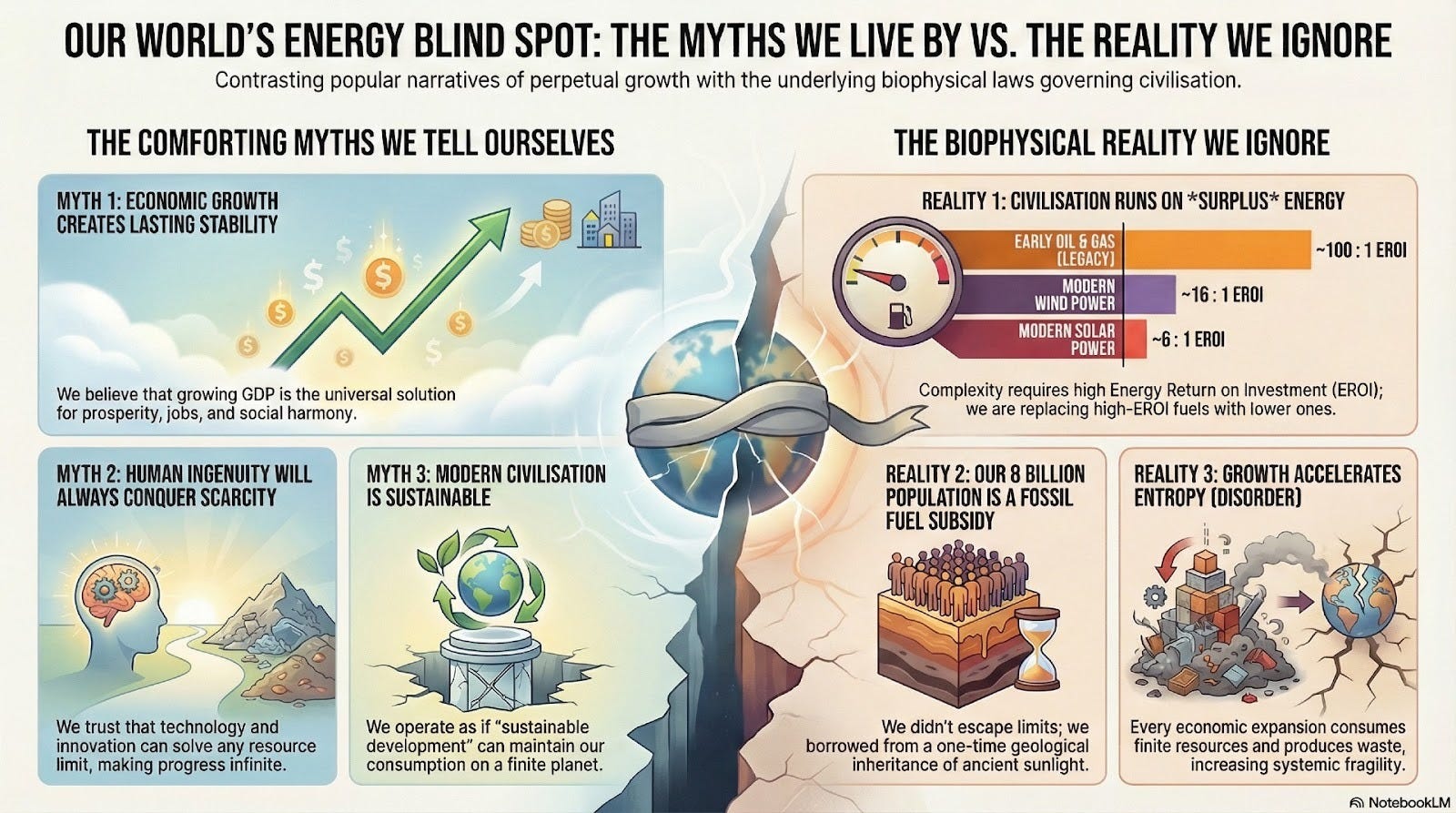
And so to the conclusion, where the practical move is to stop planning from an infinite-throughput baseline.
The chain lands in a simple reframing.
Fossil fuels acted like a civilisation-wide subsidy, not just a convenient fuel source, and EROI is how you see the size of that subsidy. As it declines, carrying capacity tightens, growth becomes a fragility amplifier, and surplus stops being a reliable proxy for security.
The interpretive move is to treat net energy as a ceiling and design for contraction, substitution limits, and buffer building, rather than betting on smooth continuation.
That does not tell you what to believe. It tells you what cannot be true at scale.
Coming soon
Curated Insights, deeper Explainers, monthly live catchups, and a moderated forum for thinking clearly about a humane population contraction—without coercion, denial, or collapse.