



Core Idea
There’s a rhythm to the environmental campaigns that flood my social media feeds each week. A polar bear on a disappearing ice floe. Plastic choking a turtle. A child’s face, eyes locked on the camera, pleading.
The tagline and topic vary, but the tug at the heartstrings is a consistent strategy.
Green messaging has become a master class in emotional manipulation. Virtue sells, after all, and virtue wrapped in urgency sells even better.
Hit the right emotional note, craft the perfect moral frame, and resistance will crumble. Hearts will open. Minds will change. Progress will march forward on a wave of shared feeling… and a dollar or two will be donated.
The problem is that hearts are tribal. What moves one person to action moves another to dig in their heels.
Environmental campaigns succeed brilliantly at converting the already converted and enraging everyone else.
Counterpoint
Get the frame right, find the perfect emotional hook, and universal buy-in will follow. It’s the golden fleece of environmental activism, that one perfect campaign that will unite humanity under the green banner.
Let’s name this fantasy for what it is… fantasy.
Mass persuasion through virtue signalling doesn’t work. It never has. What it does is sort people into camps. The logger hears nothing but condescension. The coal miner smells betrayal. Even the suburban parent, calculating petrol costs, feels the sting of implied moral failure.
These campaigns operate as if everyone starts from the same baseline of values and interests. They don’t. The farmer facing bankruptcy at the wrong end of a drought doesn’t have the bandwidth for the plight of polar bears. The factory worker watching his industry die is too stressed about his own future to respond to children’s tears with compliance. The best he can do is a little compassion.
In these circumstances environmental virtue becomes a luxury good that only the comfortable can afford to buy.
The deeper problem is that emotional appeals sidestep the real drivers of environmental destruction. They offer a catharsis without strategy. Feeling good about caring becomes more important than actually solving anything.
Meanwhile, the systems grinding away at the biosphere through industrial agriculture, fossil energy dependence, and the mathematics of infinite growth that continues untouched by our feelings.
The Real Implications
Abandon universal messaging.
Accept that environmental action happens in a divided world, not a converted one. Stop pretending that the right emotional pitch will unite opposing economic interests. It won’t.
Build strategies around division, not despite it.
Target interventions where aligned incentives actually exist… The restoration project that pays farmers. The efficiency upgrade that cuts costs. The renewable installation that creates jobs. These work because they don’t require people to abandon their interests.
Collaborate with commercial actors as partners, not converts. The mining company that needs to rehabilitate land. The agricultural corporation facing soil depletion. The manufacturing firm chasing energy savings. These relationships are transactional, not emotional. They’re also more durable than campaigns built on guilt.
Most importantly, accept opposition as a feature, as prt of what inevitably happens. It’s not a fault.
In any system worth changing, some resistance is inevitable. The goal is progress despite disagreement. Environmental strategies should be built for a world of competing interests, not a fantasy of shared values.
Thought Challenges
Pick apart the last big environmental campaign you encountered… Who shared it approvingly, and who rolled their eyes? Map the economic, cultural, and political dividing lines. Notice how the messaging reinforced existing tribal boundaries rather than crossing them.
Hunt for the quiet successes... Find instances where environmental progress happened through compromise rather than conversion. A wetland restored for flood control. Solar panels installed for cost savings. Species protected for tourism revenue. Study what made these work when louder campaigns failed.
Monitor your own reactions to green messaging... When does it inspire you, and when does it irritate? What triggers the shift? Notice how your response depends as much on your circumstances as your values.
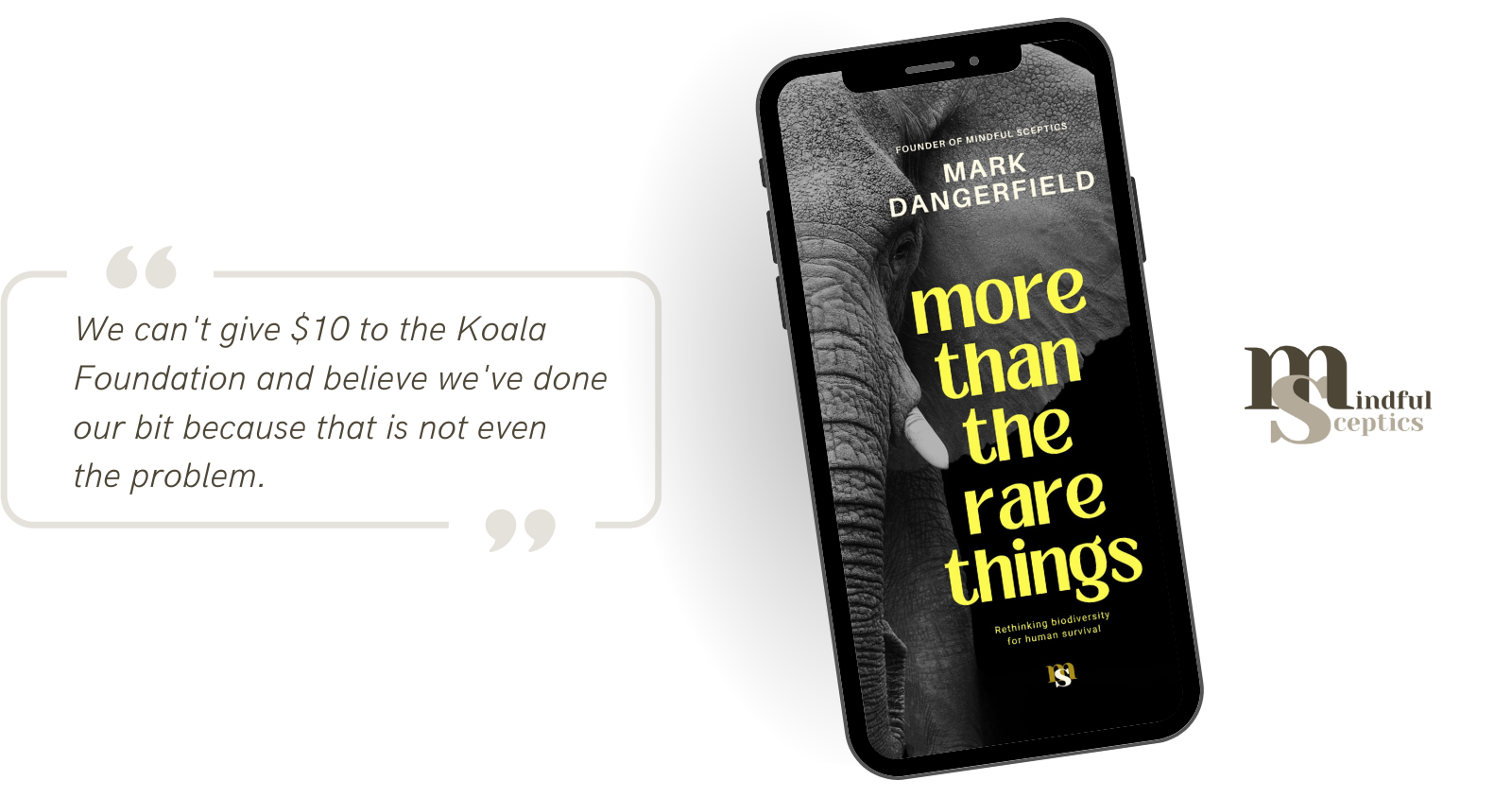
And if these are too challenging, why not read this book…
Closing Reflection
Being a mindful sceptic means dispensing with flattering stories about human nature.
People don’t abandon their interests because of perfect messaging. They change when new interests align with old ones.
Environmental progress happens in the margins where profit meets purpose, where necessity meets opportunity, where opposing forces find unexpected common ground.
Green persuasion as mass conversion is a dead end. Green persuasion as targeted collaboration is where the work begins.
Evidence Support
Brulle, R. J., Carmichael, J., & Jenkins, J. C. (2012). Shifting public opinion on climate change: An empirical assessment of factors influencing concern over climate change in the U.S., 2002–2010. Climatic Change, 114(2), 169–188.
TL;DR… partisan media and political polarization are the strongest predictors of shifts in climate change concern, far surpassing weather events or scientific messaging. Emotional or virtue-based campaigns rarely impact those outside the group already predisposed to environmental attitudes.
Relevance to insight… universal green appeals often reinforce pre-existing divisions. The authors recommend targeted interventions, highlighting the limits of broad emotional messaging in overcoming entrenched interests.
Gromet, D. M., Kunreuther, H., & Larrick, R. P. (2013). Political ideology affects energy-efficiency attitudes and choices. Proceedings of the National Academy of Sciences, 110(23), 9213-9218.
TL;DR… conservatives were less likely to choose energy-efficient products carrying an environmental label, even with personal economic incentives. Messaging shaped by virtue alienated some groups who responded positively only to direct cost savings.
Relevance to insight… environmental appeals succeed only among sympathetic subgroups, and that economic incentives bridge ideological divides. It bolsters the case for abandoning universal messaging in favour of pragmatic, interest-based strategies.
Feinberg, M., & Willer, R. (2013). The moral roots of environmental attitudes. Psychological Science, 24(1), 56–62.
TL;DR… Messaging framed in self-transcendent moral terms (care, fairness) motivates progressives but triggers resistance among conservatives; division decreases when using varied moral frames (purity, loyalty).
Relevance to insight… polarizing effect of one-size-fits-all virtue messaging and the need to recognize foundational moral and cultural wiring in campaign design.
Kahan, D. M., Jenkins‐Smith, H., & Braman, D. (2011). Cultural cognition of scientific consensus. Journal of Risk Research, 14(2), 147–174.
TL;DR… Cultural worldviews strongly influence perceptions of scientific messages about climate change, with individuals selectively interpreting information through their own value systems.
Relevance to insight… messaging does not persuade across cultural boundaries and often deepens division, making collaborative, targeted approaches essential.
Bain, P. G., et al. (2016). Co-benefits of addressing climate change can motivate action. Nature Climate Change, 6, 154–157.
TL;DR… When climate action was framed around co-benefits (health, economy), support increased across ideological lines, compared to pure moral or environmental appeals.
Relevance to insight… compromise and practical incentives unite divided groups and are more persuasive than advocacy anchored in virtue or emotion alone.
The efficiency of environmental campaigns hinge on their realism, their ability to accept division, leverage incentives, and target interventions rather than chasing consensus by sentimental force.