


Fossil fuels are an inheritance
The story we tell ourselves about the last two centuries is that human ingenuity defeated scarcity. Thomas Malthus predicted catastrophe, but instead we got tractors, fertiliser, vaccines, and cities that glow all night. The population soared from 2 billion to 8 billion, and we took it as proof that warnings about limits were just the pessimism of small minds.
But the triumph was not strictly ingenuity. What we called progress was only possible through access to an energy reserve built over 300 million years of compressed ancient sunlight. It was a subsidy.
Coal, oil, and gas did not disprove Malthusian limits, they temporarily raised Earth’s human carrying capacity by flooding the system with stored energy. Every extra billion people alive today exists because we burned through a finite inheritance at extraordinary speed.
We did not escape the Malthusian trap. Instead, we borrowed our way out, and the bill is coming due.
Counterpoint
Technology did not defeat scarcity, it postponed it.
The fossil fuel era has given us an army of energy slaves, pushing, pulling, engineering and fertilising the natural world to give humans more food, places to live and, for some, remarkable lifestyles. It also gave us time and opportunity to think and innovate. And we did, especially when there was a dollar in it and the evidence piled up that limits are always provisional, always defeated by the next wave of human cleverness.
Julian Simon argued we would never run out because substitution and innovation always arrive in time. Cornucopians still point to declining resource prices and rising GDP as proof that scarcity is a myth.
Now take a look at this graph.
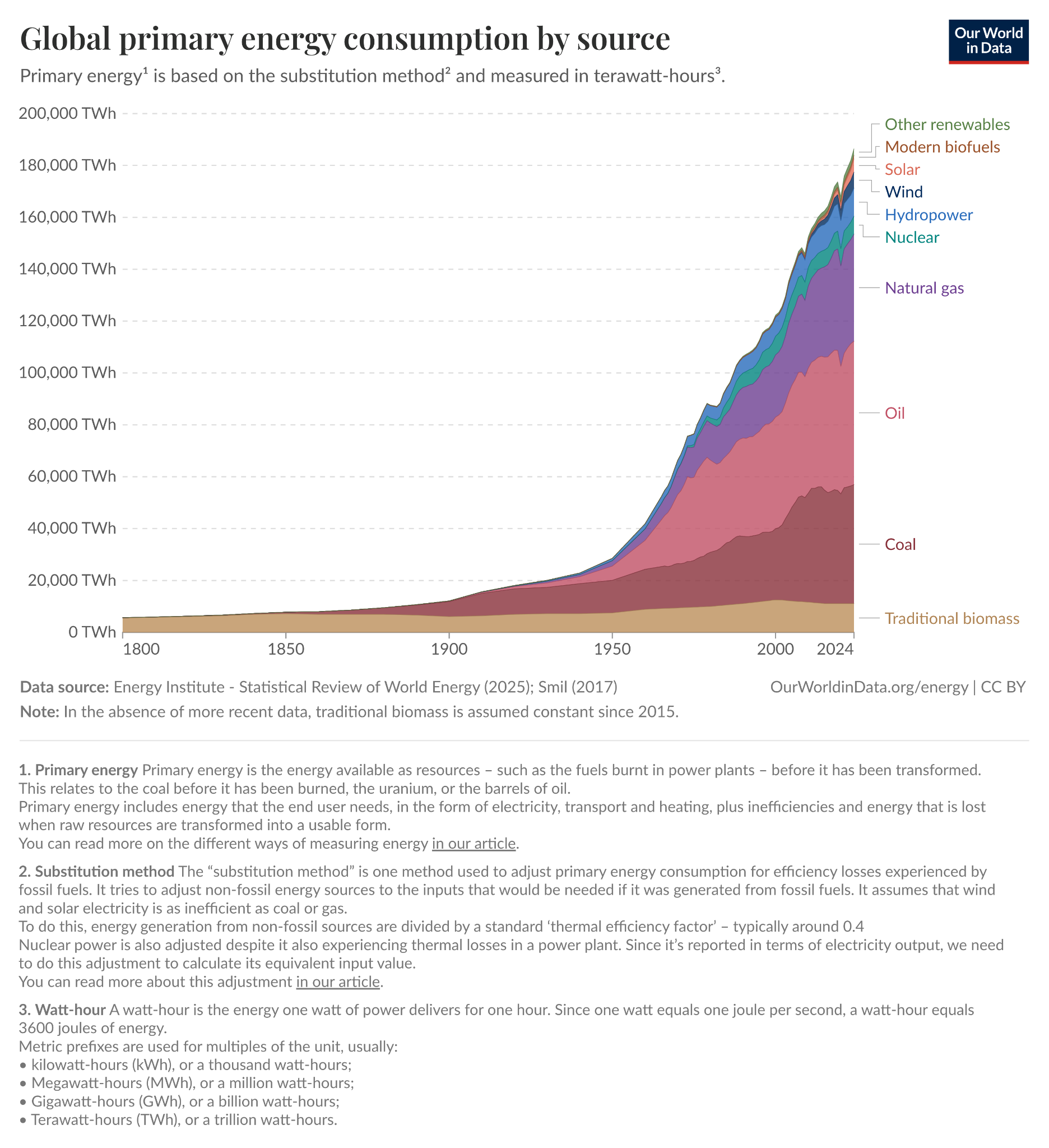
Strip away fossil fuels and the energy availability reverts closer to where it stood in 1800. Most of the alternative energy sources, the wind, solar and modern biofuels, are both a tiny percentage of the total energy use and have been added to the pile rather than offering substitution.
Pre-industrial agriculture supported roughly 1 to 2 billion people, not 8 billion. Modern crop yields are not the result of better seeds alone. They depend on synthetic nitrogen fertiliser, which is made from natural gas. Transport those crops? Diesel. Pump the water? Electricity from coal or gas. Manufacture the machinery? Steel forged with coking coal. The entire system is fossil energy converted into food.
The same logic applies everywhere. Medicine, construction, communication, heating, cooling—all of it runs on the same subsidy. What we mistake for a sustainable industrial civilisation is actually a heat engine converting ancient carbon into temporary abundance.
Even the so-called energy transition depends on this subsidy, too. Solar panels, wind turbines, batteries through every stage of their supply chain are built using fossil fuels. Mining rare earths, smelting metals, fabricating components, shipping globally, getting you to the shops… none of it runs on sunlight and good intentions. Renewables are not replacing the system. They are being assembled by it.
Here’s the thing.
We are not living in a world of 8 billion because we got smarter. We are living in a world of 8 billion because we found a one-time energy windfall and spent it as fast as we could.
When that windfall declines, so does the carrying capacity.
What we call civilisation is a population overshoot propped up by combustion.
Thought Challenge
Map your fossil fuel dependence... Track a single day of your life and identify every point where fossil energy enters from the food you eat, the transport you take, the heating or cooling of your home, the goods you purchase, the medical care you rely on. What percentage of this could function without coal, oil, or gas? Be honest.
Compare yields, then and now... Look up pre-industrial agricultural yields per hectare for wheat or rice, then compare them to modern industrial yields. What accounts for the difference? Follow the trail to nitrogen fertiliser, mechanisation, irrigation. Then follow those trails to their energy source. The gap between the two numbers is the subsidy.
Audit a green technology... Choose any renewable energy technology and trace its full supply chain. Where is the lithium mined? How is the silicon purified? What powers the factory? What transports the finished product? At each stage, identify the energy source. Notice how often the answer is fossil fuels. Can this system build itself without the thing it is meant to replace?
All three exercises dismantle the comfortable story because they force you to see the subsidy.
Closing reflection
Being a mindful sceptic is about seeing the difference between what we achieved and what we inherited, between what is sustainable and what is simply not yet collapsed.
Malthus was not wrong in his prediction. He was early. Ancient sunlight gave us two centuries to pretend otherwise, and that pretence is ending.
Sure, he had some obnoxious ideas about how to fix a booming population, but that should not blind us to the basic biophysics he was describing.
Fossil fuels did not defeat scarcity. They deferred it, which is not the same as escape.

Evidence Support
Wackernagel, M., Schulz, N. B., Deumling, D., Linares, A. C., Jenkins, M., Kapos, V., … Randers, J. (2002). Tracking the ecological overshoot of the human economy. Proceedings of the National Academy of Sciences, 99(14), 9266–9271.
TL;DR… calculates the ecological footprint of humanity and compares it with the biosphere’s regenerative capacity, concluding that human demand exceeded global biocapacity by about 20 percent around 1999, indicating clear ecological overshoot. This overshoot is structurally linked to industrial energy and material use, especially the fossil‑fuel–driven expansion of agriculture and infrastructure that allows current population and consumption levels.
Relevance to insight… quantitative backbone for the claim that today’s 8‑billion‑person, high‑consumption civilisation sits beyond long‑term carrying capacity rather than in a new equilibrium. By explicitly framing the global economy as overshooting regenerative limits, it supports the idea that fossil fuels created a temporary spike in effective carrying capacity rather than a permanent escape from Malthusian constraints. It also reinforces the point that once the fossil subsidy weakens, system pressure must be relieved somewhere, whether through reduced consumption, reduced population, or both.
Hall, C. A. S., Lambert, J. G., & Balogh, S. B. (2014). EROI of different fuels and the implications for society. Energy Policy, 64, 141–152.
TL;DR… estimates of energy return on investment (EROI) for major fuels and shows that conventional oil, gas, and coal historically provided very high net energy compared with most renewables and unconventional fuels. The authors argue that complex industrial societies require high average EROI to maintain infrastructure, services, and social complexity, and that declining fossil EROI constrains future economic and social stability.
Relevance to insight… insight hinges on the claim that fossil fuels massively lifted carrying capacity by providing huge amounts of surplus energy, and EROI is the metric that makes that surplus visible. The net energy surplus from fossil fuels is precisely what allowed population, urbanisation, and complexity to explode in the last two centuries. Most renewables and unconventional sources deliver lower net energy, which directly supports the sceptical claim that a full “energy transition” cannot simply swap in low‑EROI sources and expect to maintain an 8‑billion‑person, high‑throughput civilisation unchanged.
Krausmann, F., Gingrich, S., Eisenmenger, N., Erb, K.‑H., Haberl, H., & Fischer‑Kowalski, M. (2009). Growth in global materials use, GDP and population during the 20th century. Ecological Economics, 68(10), 2696–2705.
TL;DR… using long‑term material flow data, this paper shows that the 20th century saw a dramatic shift from biomass‑based societies to fossil‑fuel‑based industrial metabolisms, with material and energy throughput growing far faster than population. The authors demonstrate that fossil fuels enabled a qualitative socio‑metabolic transition, decoupling human energy use from local ecological productivity and allowing unprecedented growth in GDP and resource use.
Relevance to insight… provide empirical support for the idea that the fossil fuel era is a historical rupture rather than a simple extension of pre‑industrial trends. Their findings align with the “ancient sunlight” frame in the insight, showing that exogenous fossil energy allowed humanity to appropriate far more resources than local ecosystems could support, effectively inflating carrying capacity. Once that exogenous flow contracts, the underlying biophysical limits reassert themselves, which is precisely the Malthusian dynamic the insight argues has only been postponed, not abolished.
Pimentel, D., & Pimentel, M. (2003). Sustainability of meat‑based and plant‑based diets and the environment. American Journal of Clinical Nutrition, 78(3), 660S–663S.
TL;DR… quantifies the fossil energy inputs required for different types of diets and agricultural systems, showing that modern industrial food production is extremely energy intensive and heavily dependent on fossil fuels for fertilisers, machinery, transport, and processing. Current high yields and food availability are inseparable from this fossil energy subsidy, and that energy use per calorie of food can be an order of magnitude higher in industrial systems than in traditional ones.
Relevance to insight… insight claims that the jump from roughly 2 billion to 8 billion people is inseparable from fossil‑fuel‑driven agriculture, and Pimentel’s work makes that link concrete at the level of calories and joules. By showing how deeply modern food systems are wired into fossil inputs, this paper backs the argument that current population levels represent an energy‑subsidised overshoot rather than a stable agrarian achievement. It also supports the sceptical reading of “green” or “sustainable” food narratives that ignore underlying fossil energy flows in fertiliser, irrigation, transport, and processing.
Moriarty, P., & Honnery, D. (2016). Can renewable energy power the future. Energy Policy, 93, 3–7.
TL;DR… while renewables can and should expand, their realistic potential is likely insufficient to sustain current global energy use levels once fossil fuels decline. They highlight issues of intermittency, storage, land and material requirements, and lower system‑level EROI, concluding that future societies will probably have to adapt to lower per‑capita energy availability.
Relevance to insight… supports the insight’s scepticism about the “energy transition” story that assumes renewables can seamlessly replace fossil fuels while keeping an 8‑billion‑person, high‑consumption civilisation intact. Even optimistic renewable scenarios imply significant reductions in available net energy, which is functionally equivalent to a reduction in carrying capacity at current consumption patterns. The fossil fuel pulse did not remove limits, it masked them, and a serious transition means confronting both energy descent and the political taboo around overshoot.