



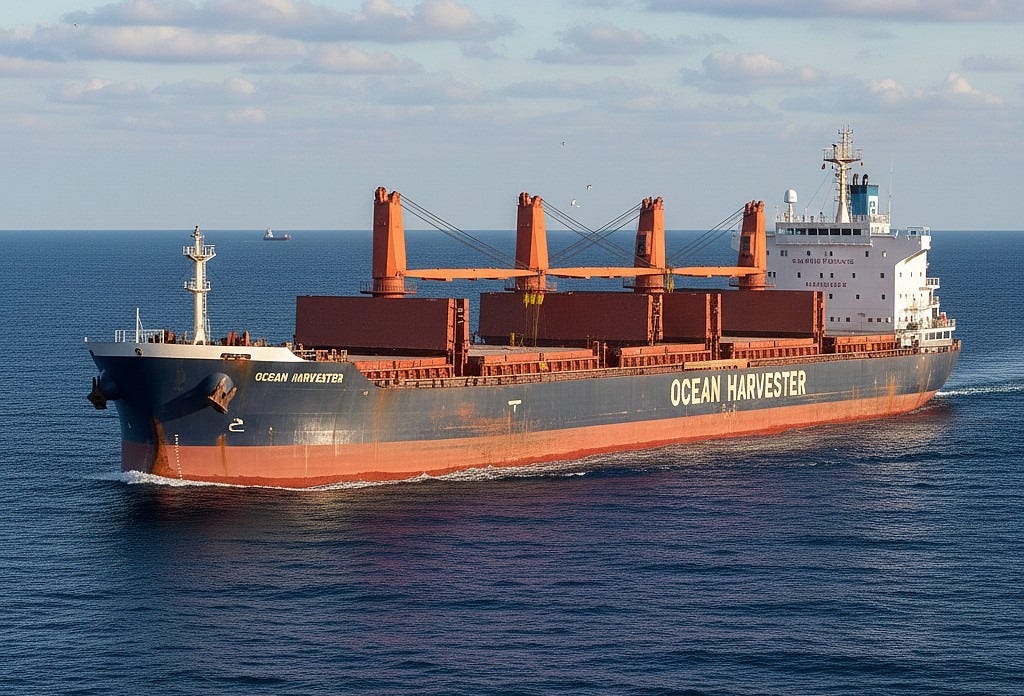
A bulk carrier eases out of port, holds full of pale granules that look like oversized salt. No branding. No romance. Just tonnes.
Upstream, those granules become yield. Downstream, they become runoff. Today forty ships and tomorrow there’s another forty.
This is the quiet machinery of modern food. Our system runs on fertiliser, whether we think about it or not.
The Hard Number
Industrial nitrogen is one of the quiet load-bearing pillars of modern life. Based on 2024–2025 production figures roughly 112 million metric tonnes of nitrogen nutrient (N) per year is manufactured which is roughly ~450 million tonnes if you count the full commercial product weight.
Fertiliser is primarily handled as a high-volume, low-value commodity, which means the logistics are heavily optimised for cost and moisture protection. Roughly 85% of all fertiliser is shipped in bulk.
Just to move one day’s worth of global nitrogen fertiliser products as total product weight, translates to roughly
40 bulk carrier loads every day
The majority of solid fertilisers (Urea, Potash, Phosphates) are transported in large ocean vessels, typically ranging from 15,000 to 45,000 deadweight tonnes (DWT). These Handysize or Handymax bulk carriers are easily handled at fertiliser ports and carry the cargo poured directly into the ship’s holds.
Framing the hard number
So the mental image is not a few giant vessels now and then. It’s 40 bulk carrier loads every day, on average, just to move one day’s worth of global nitrogen fertiliser products.
This means that the real system lives in ports, rail, barges, blending plants, bags with liners, hatch covers, insurance, and corrosion control. High-volume, low-value commodity logistics are about bulk, optimised for cost, and protected obsessively from moisture because many nitrogen fertilisers are hygroscopic and cake when damp.
And then with fertilisers there is the awkward category of ammonium nitrate, which is regulated as an oxidiser with explosive risk. That comes with routing, storage, and insurance point. The chemical nature of the product shapes the physical network that can carry it.
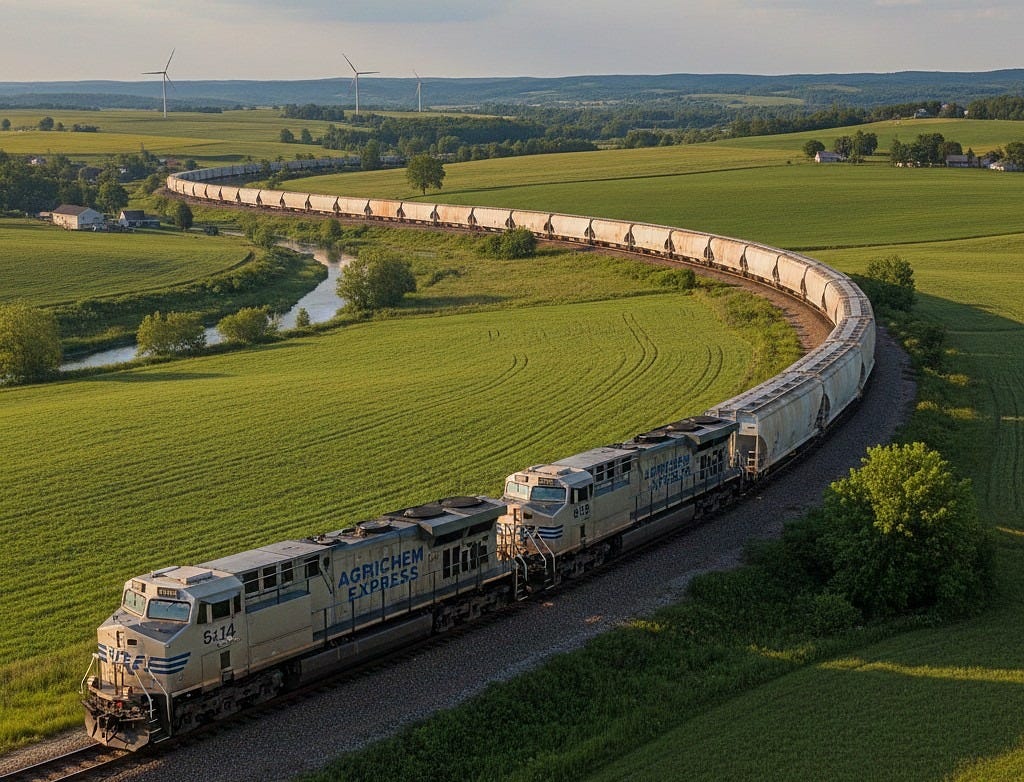
Inland transport to move bulk material from ports to rural blending plants relies heavily on river barges as the most cost-effective method and unit trains where the entire train is dedicated to a single product.
In the rail industry, fertiliser moves in a covered hopper car that holds roughly 100 tons of product. For the cargo of a 30,000 tons Handymax, you would need exactly 300 cars.
Then the physical constraint shows up. A standard hopper car is approximately 60 feet (18.3 meters) long including the couplers. Multiply that out and the single 300-car train runs to over 3 miles long which is way beyond standard rail infrastructure length and weight ceilings. So this load is usually split into three separate unit trains of 100 cars each.
In practice, offloading a Handymax doesn’t happen all at once. Ports run a unit-train rhythm. Most facilities have enough track space to stage 100 to 110 cars at a time, load them, clear them, repeat. And the clock is set by the belt. To move 30,000 tons from the ship’s hold into railcars typically takes 24 to 48 hours of continuous conveyor operation.
Each 100 car train is a mile long (close to 2 km) and weighs 13,000 tons and takes at least 2 locomotives to pull it. Once the train is up and running the locomotives burn roughly 20 litres per km for a train already at speed on flat ground.
Behind the hard number
Some basic nitrogen.
Plants need nitrogen to grow. The atmosphere is mostly nitrogen gas, but it’s locked up as N₂, which most crops can’t use directly. Nature’s workaround is slow as microbes fix nitrogen, lightning helps a bit, and legumes pull tricks with symbiotic bacteria. The natural flow is real, but limited.
The industrial workaround is blunt and brilliant. The Haber-Bosch process takes nitrogen from the air and combines it with hydrogen to make ammonia. The most convenient source of hydrogen for this industrial process is natural gas. That means industrial nitrogen is not just a chemical story. It’s an energy story.
Once you have ammonia, you have the precursor for almost all nitrogen fertilisers including urea, ammonium nitrate, UAN solutions, and more. The nutrient numbers are easy to confuse because nitrogen can mean the nitrogen content (N) or the total mass of the product carrying that nitrogen. A tonne of urea is not a tonne of nitrogen. The difference matters because the ships, pipelines, warehouses, and emissions move the whole product, not just the nutrient.
The main constraint to name up front is the energy constraint: if your nitrogen comes from natural gas, you inherit natural gas supply, price, geopolitics, and emissions. That constraint doesn’t care about slogans.
The Invisible System Behind the Visible Story
The visible story is food. There seems to be plenty of it for those of us who get sustenance from the fridge.
But for the majority of people daily food provisioning still runs through informal and traditional channels (open markets, small family shops, street vendors) and through own-production, especially for fresh foods. India plus developing Sub-Saharan Africa already implies about 2.6 billion people in regions where supermarkets are unlikely to be the majority food source for most households. Once you add large parts of South and Southeast Asia beyond India, and many low- and lower-middle-income countries, a reasonable global estimate is that the number is comfortably above 3 billion and plausibly in the 4–5 billion range.
Not surprisingly, when someone says we need to feed the world, the conversation jumps to crops, diets, waste, and farming practices. All important. But the enabling substrate is often industrial nitrogen.
Synthetic nitrogen supports nearly 50% of the world’s food supply and it means modern population and modern yield levels are partly a reflection of fossil energy converted into fertiliser.
It creates at last four core dependencies.
Natural gas supply and price. If the nitrogen for fertiliser is derived from gas, then gas scarcity, price spikes, and sanctions echo into fertiliser price, then into planting decisions, then into food prices. The chain is long, but the coupling is real.
Industrial concentration and geopolitical clustering. Fertiliser production is concentrated in China, India, Russia, and the United States, together accounting for over half of global production. Concentration is an efficiency story and a fragility story. If you want cheap tonnes, you cluster near feedstock and infrastructure. If you want resilience, you diversify. The system tends to choose cheap.
Logistics and handling reality. Because fertiliser is low value per tonne relative to the cost of moving it, the system becomes a logistics game of bulk shipping, barges, unit trains, blending plants, storage constraints, moisture protection, and the unglamorous work of keeping product dry and flowing. Storage and port constraints are physical, not rhetorical.
What’s missing from the popular story is that most sustainable agriculture narratives talk as if nitrogen is a dial we can turn without disturbing the machine that makes it. But nitrogen is not a policy memo. It’s an industrial metabolism.
And there is a deeper pattern
Industrial nitrogen sits at the intersection of two stories. One is about nature’s limits in soil fertility, nutrient cycles, ecosystems. The other is industrial mastery of chemistry, scale, and engineering.
Haber-Bosch is one of the few technologies that genuinely deserves the word civilisational. It is also a perfect example of why progress narratives become theatre. Once a system has been built around a fossil-powered input, institutions start defending the input’s continuity as if it were a law of nature.
Governments want food price stability. Fertiliser producers want predictable demand, and they’ll defend asset lifetimes. Farmers, often margin-constrained, can’t gamble on yield. Investors tend to prefer incremental retrofits—carbon capture, “blue” ammonia—over uncertain overhauls. And climate commitments, in turn, encourage re-labelling pathways as blue or green to preserve industrial continuity.
So the comforting story persists. We’ll keep the yields, keep the scale, swap the energy source, and everything will be fine.
Sometimes that story will be partly true. But it competes with the constraints of energy density and infrastructure inertia. For example, green nitrogen requires vast renewable electricity, electrolysers, new ammonia handling capacity, and time. Meanwhile, the existing machine is already built, already financed, and already feeding people.
The trap isn’t malice. It’s that complex systems prefer continuity, and institutions prefer narratives that make continuity sound virtuous.
Back to the Front
Those pale granules in the ship’s hold don’t look like a civilisation. They look like cargo. But the rhythm played out in dozens of ships, trains and barges every day is our food system quietly admitting what it runs on.
Air, yes. And also gas, steel, ports, and the small, steady agreement to keep the machine fed.
Being a Mindful Sceptic
A mindful sceptic uses curiosity and critical thinking to rigorously question ideas and demand evidence, while being aware of what matters, when it matters, and how to avoid the trap of cynicism.
Track the constraint, not the slogan. Start by inventorying the energy, feedstock, water, steel, ports, and time that make up the process. If the input is natural gas, don’t let the story pretend it’s mostly air.
Separate nutrient from product mass. When someone cites nitrogen, ask if they mean nitrogen nutrient (N) or total fertiliser product. Ships move product mass. Plants care about nutrient.
Follow the upstream dependency chain. Natural gas → hydrogen → ammonia → urea/ammonium nitrate → logistics → on-farm application → yields → runoff/emissions. If a proposal touches only one link, assume displacement elsewhere until proven.
Beware efficiency narratives. Cheaper fertiliser often leads to more use, not less. That’s not a moral judgement. It’s basic rebound. Lower the unit cost of nitrogen, and you tend to expand nitrogen-intensive production unless something else constrains it.
Ask what must stay true. For green ammonia to matter at system scale, what has to stay true about electricity costs, electrolyser deployment, storage, shipping, and farmer affordability? If the answer is a lot, downgrade certainty.
Mindful Momentum
Do a nitrogen check on one meal this week.
Pick a dinner you eat often. Write down the main ingredients and for each one, ask:
Is it nitrogen-intensive (grains, oilseeds, industrial vegetables, feedlot meat)?
Where did the nitrogen likely come from (legumes/biological fixation, manure, or synthetic fertiliser)?
Where does the nitrogen go after you eat it (sewage system, landfill, waterways)?
What would have to be true for that nitrogen to “cycle” rather than leak?
Don’t turn it into virtue. Turn it into perception.
Key Points
The machinery and the scale. Industrial nitrogen turns atmospheric nitrogen into fertiliser mainly via Haber–Bosch, typically using hydrogen derived from natural gas. Output in 2025 was ~110–115 million tonnes/year as nutrient N, and ~450 million tonnes/year as total product mass.
The logistics and the energy coupling. At ~450 million tonnes/year, that’s ~1.23 million tonnes/day—roughly 40 bulk carrier loads per day at 30k tonnes each. And it’s welded to energy, specifically ~4% of world natural gas use and ~1.5% of global CO₂ emissions.
The transition story and the sceptic’s posture
Green ammonia is the growing storyline, but today’s share is stated as <2% (as of 2025), with the binding constraint being infrastructure and energy, not ambition.The institutional theatre is predictable. Continuity narratives win because they stabilise food prices, protect assets, and simplify politics—so a mindful sceptic tracks constraints, checks rebound, and refuses orphan numbers.