



Core Idea
Conservation campaigns excel at evoking emotions.
The young volunteer, wearing a bright t-shirt and carrying a donation bucket, speaks with passion about saving the koala. Her eyes shine with purpose. The language is urgent, emotive, and designed to bypass your rational filters and head straight for your wallet.
But ask her how many koalas actually exist?
She’ll pause. Maybe she’ll mention some numbers. Perhaps 329,000, or was it 144,000, or 605,000? The range is so wide it’s meaningless.
Press her further and ask. Do we know if populations are declining, stable, or recovering? If she is honest, she will shrug. More likely, she will claim they are declining.
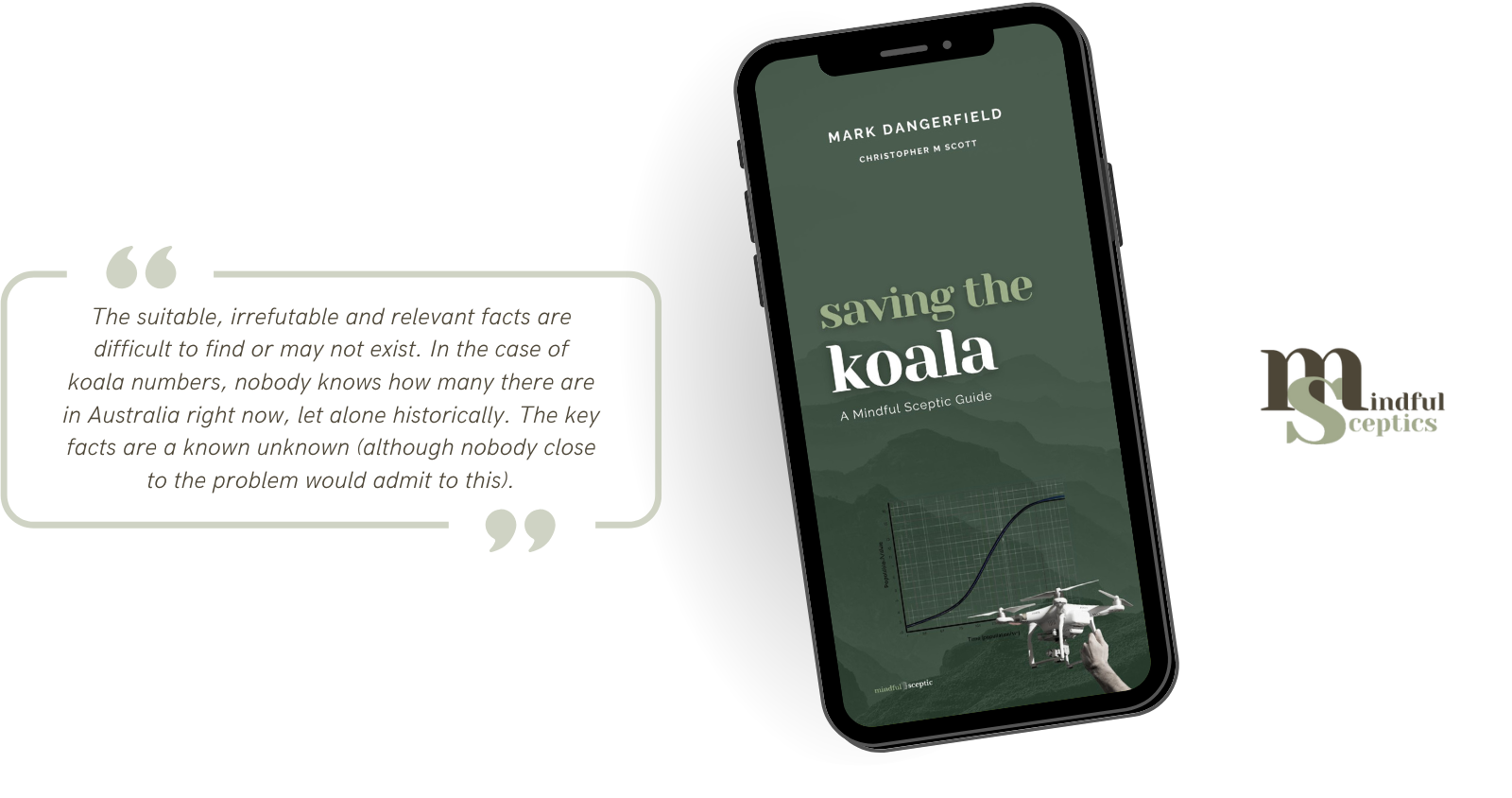
The truth is that suitable, irrefutable and relevant facts are difficult to find or may not exist. Until a report from detailed population and habitat surveys in late 2025, this was true for the koala in NSW, the Australian state that is bigger in land area than every European country except Russia. Not even the scientists knew how many.
When hard data proves elusive or contradictory, emotional appeals rush in to fill the space. The more uncertain the facts, the more dramatic the rhetoric becomes.
Gathering her wits, the young volunteer will assure you it’s devastating, a crisis, extinction. Words that generate feelings, where evidence fails to generate knowledge.
A mindful sceptic recognises this pattern.
When passion increases in inverse proportion to precision, when certainty rises as data quality falls, that’s when your sceptical radar should start humming.
Counterpoint
The standard response from the conservationist goes something like this…
We don’t need perfect data to know something urgent is happening. The trends are clear enough. Besides, by the time we have definitive proof, it will be too late.
Of course, we have to act on incomplete information. Even you science types tell us that precaution is wise when dealing with irreversible losses.
And there’s truth in this.
Conservation does face genuine time pressures, and waiting for perfect data can be a form of paralysis.
But here’s what the mindful sceptic notices. Emotional campaigns don’t just acknowledge uncertainty; they actively obscure it. They present contestable claims as settled facts. They use normative language like only 329,000 koalas left without explaining what only means in this context.
Is that number historically high or low? Is it stable or changing? The emotive framing makes these questions seem almost impertinent.
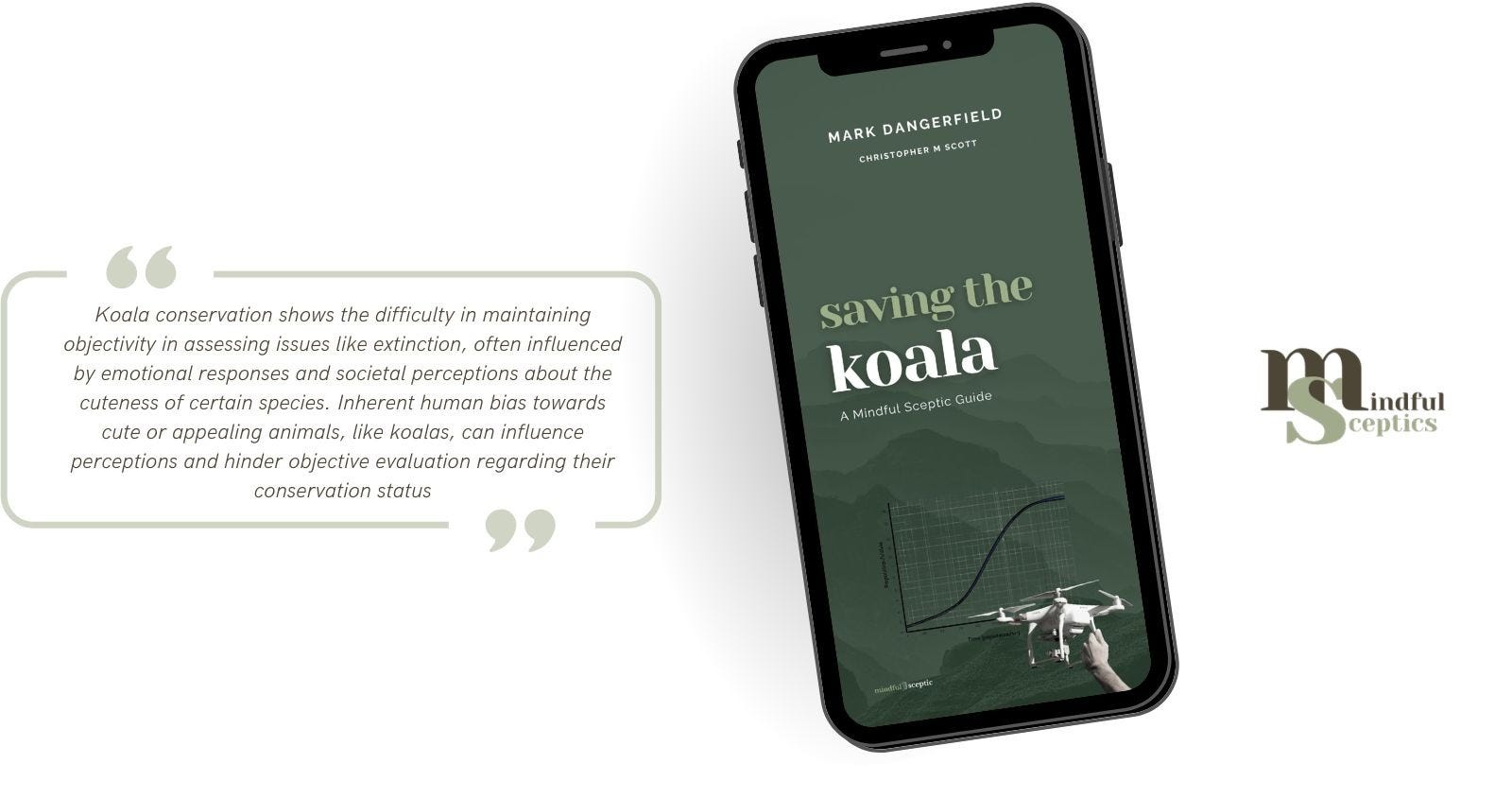
More troubling is that emotion-driven narratives resist course correction. When subsequent research suggests koala populations might be more stable than claimed, or distributed differently than assumed, the campaigns rarely adjust.
The story has taken on a life of its own, independent of the evidence that supposedly supports it.
The real counterpoint is uncomfortable... emotion has become a substitute for evidence, not its ally.
Thought Challenges
Trace the data trail… Next time you encounter an urgent conservation claim, dig backwards. Where do the numbers come from? When you find the original research, what caveats did the scientists include that disappeared by the time it reached the campaign materials? Note how certainty increases as you move from peer-reviewed papers to press releases to fundraising appeals.
Map the emotion markers… Choose a conservation website or campaign and highlight every emotionally charged word—devastating, crisis, heartbreaking, urgent. Now look for the factual claims. What’s the ratio of feeling-words to data points? High emotion-to-evidence ratios are diagnostic of evidence vacuums.
Both exercises train the sceptical eye. You learn to recognise when passion is taking on tasks that should be left to proof.
Closing Reflection
Being a mindful sceptic about evidence vacuums doesn’t make you anti-conservation or heartless about suffering animals.
It makes you a better ally to genuine conservation by helping distinguish between problems that exist and problems that have been emotionally constructed.
The koala example reveals something larger about how modern institutions operate. When evidence is thin, emotion becomes the currency. When uncertainty is high, certainty in messaging increases to compensate. The organisations doing this aren’t necessarily acting in bad faith because they may genuinely believe their cause is just and their urgency warranted.
But for the mindful sceptic, this is precisely when vigilance is most needed.
The absence of evidence is not evidence of absence, but neither is the presence of passion evidence of anything except passion itself.
Facts are not feelings. When the two become confused, both suffer.
Evidence Support
Lunney, D., Stalenberg, E., Santika, T., & Rhodes, J.R. (2014). Extinction in Eden: Identifying the role of local government in species conservation. Pacific Conservation Biology, 20(1), 6–20.
TL;DR… population estimates for species such as the koala are highly uncertain due to fragmentary or missing data, yet emotive campaigns drive urgent public and political responses out of proportion to actual extinction risk. It documents how local government policies are shaped more by public sentiment, media pressure, and the symbolic use of species like koalas than by scientific consensus on their population dynamics.
Relevance to insight… The paper provides direct evidence that conservation decisions for charismatic species often leap ahead of the data due to public emotional investment, exposing an evidence vacuum that is exploited both by campaigners and policymakers.
Gulsrud, N. M., Hertzog, K., & Shears, I. (2018). Innovative urban forestry governance in Melbourne: Investigating “green placemaking” as a nature-based solution. Environmental Research, 161, 158–167.
TL;DR… explores broader conservation narratives in Australia, showing that urban forestry and conservation policy are often designed to trigger the emotions of city dwellers rather than the actual ecological needs outlined by evidence. Feel-good narratives, not measured outcomes, often drive resource allocation.
Relevance to insight… supports the critique that conservation strategy is frequently dictated by emotional campaigns (“feel-good” stories about saving nature) regardless of the hard evidence needed for long-term sustainability.
Veríssimo, D., MacMillan, D. C., & Smith, R. J. (2011). Toward a systematic approach for identifying conservation flagships. Conservation Letters, 4(1), 1–8.
TL;DR… meta-analysis of conservation flagships reviews dozens of case studies and concludes that flagship species selection and related funding decisions are overwhelmingly driven by public emotion, symbolism, and marketing potential, not by scientific assessments of ecosystem needs or conservation efficacy.
Relevance to insight… lays the foundation for understanding the systematic evidence vacuum engineered by emotional selection and validation of certain species and narratives in flagship campaigns.
Bruskotter, J. T., & Shelby, L. B. (2010). Human dimensions of large carnivore conservation and management: Introduction to the special issue. Human Dimensions of Wildlife, 15(5), 311-314.
TL;DR… human attitudes to carnivore conservation, the authors show how emotional responses of fear, admiration, or sentimental attachment, interfere with objective risk assessments and policy formation. Management is often driven by stories and symbols rather than data, leading to persistent information gaps.
Relevance to insight… underscores the psychological basis for emotion-driven conservation priorities, revealing how an evidence vacuum is not only a technical problem, but a chronic feature of public and institutional reasoning in conservation.
Emotionally charged campaigns, particularly focusing on charismatic or iconic species like the koala, routinely overwhelm scientific uncertainty or the absence of evidence. In the public mind and political sphere, evidence takes a back seat to stories that mobilise sentiment and tribal identity. This evidence vacuum is not merely a gap to be filled with better research, but a structural feature of the way conservation is governed and sold—often at the expense of rigorous, objective outcomes.