



Core Idea
Denial is not stupidity. It is a feature of the human mind, shaped by evolutionary pressures over hundreds of thousands of years.
When identity or survival feel threatened, the brain stops tracking truth and starts managing threat. When confronted with unbearable contradictions, the mind does what it does best to resolve them. It simplifies, filters, and protects.
This is what happens when a species capable of abstract thought encounters information that contradicts its need for stability, safety, and status.
We tell ourselves stories to avoid the uncomfortable.
We focus on the immediate, the tangible, and the controllable.
The mind cannot hold two opposing ideas comfortably. Either the future is manageable, or it is not. Either the system works, or it does not. Most people, most of the time, choose the comforting story over the unsettling evidence.
This comes across as denial, but denial is not a failure of intellect. In fact, it requires great intellect for the brain to be convinced by the story. Denial is an adaptive response to cognitive dissonance that would otherwise paralyse us. Rather than try to juggle conflicting evidence, we ignore it all and carry on with our day.
Personal denial about resource limits, ecological overshoot, and collapse is a consequence of the same basic biology. The threat-reduction mechanism that protects the individual also protects the worldview.
Institutional denial draws on the same principle. Organisations that acknowledge systemic limits face costs that those deferring acknowledgement do not. Most institutions defer or ignore costs to ensure survival.
Counterpoint
The conventional approach assumes that denial is a knowledge deficit. If people only knew the facts, they would act rationally. If activists communicate the science more clearly, if governments fund better campaigns, if leaders model the right behaviour, then denial will dissolve.
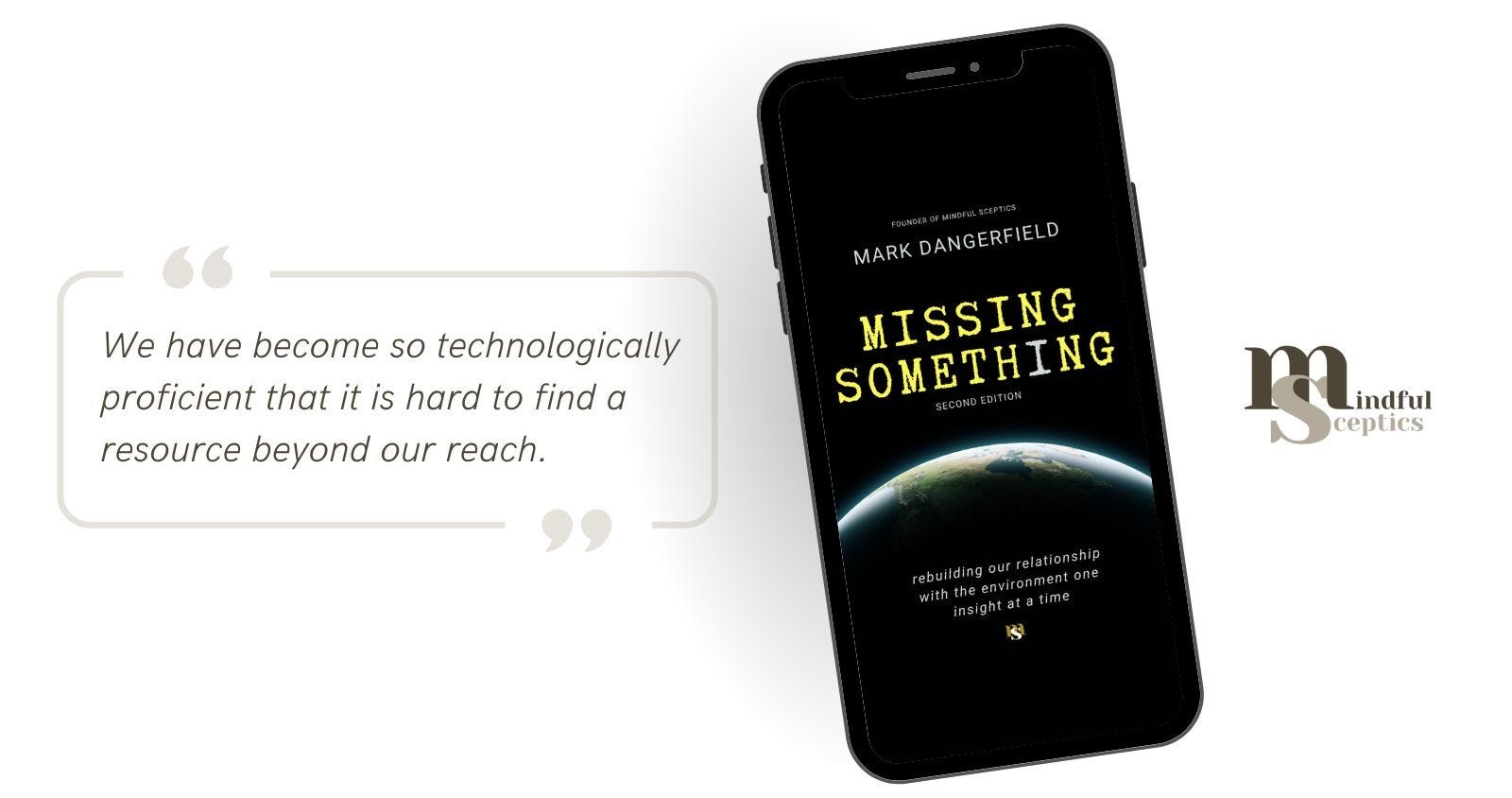
I believed this myself and even made it the theme of my second book, Missing Something, that assumed awareness was enough to change the world.
This is not how humans work.
When you see denial as self-protection, it makes sense that no amount of evidence will easily shift it. You can show someone the graphs, the models, the peer-reviewed papers, the satellite images of collapsing ice sheets. They will nod, and may even agree.
Then they will go home and act as though nothing has changed. Because believing the evidence means accepting consequences they are not equipped to bear.
The assumption that rational engagement on ecological collapse is realistic ignores what psychology, evolutionary biology, and systems thinking already tell us. Humans are not rational actors. We are rationalising actors. We make decisions based on emotion, identity, social belonging, and perceived safety, then construct arguments to justify those decisions after the fact.
Worse, denial serves a function. It allows institutions to continue operating without confronting their complicity in unsustainable systems. It allows individuals to maintain their lifestyles without the psychic cost of daily guilt. Likewise, it allows governments to prioritise short-term stability over long-term survival. Voters reward the former and punish the latter.
Denial is not a problem to be solved through better messaging. It is a deeply functional response to an unbearable reality.
Expecting people to abandon it through education or advocacy is like expecting them to abandon their instinct to flinch from danger.
Thought Challenge
Track a week of public discourse… Consider political speeches, news headlines, corporate sustainability reports, or even casual conversations about the future. Look for where denial shows up, and what uncomfortable reality it is guarding against.
Look for the passive voice… the vague timelines, the assumption that technology will solve what politics cannot. Notice where the phrase “sustainable growth” appears without irony. Watch for the moment when someone acknowledges a problem, then immediately pivots to optimism without naming what would have to change.
Now turn the lens inward… Identify one comforting myth you hold about your own future. Retirement plans in a stable economy. A liveable climate for your children. Access to food, water, energy at current levels of convenience. Ask yourself what you would have to accept if that myth were false. Notice how quickly the mind flinches.
Closing Reflection
Recognising denial as functional does not lead to fatalism. Expecting people to abandon it without being offered something in return is the problem.
Education and rational argument cannot override what evolution has deeply shaped. That is a misreading of the mechanism. Treating denial as moral failure compounds it.
Strategies that offer alternative stability have a better record than frontal confrontation with unbearable realities. Communities and framings that allow reality acknowledgement without identity loss lower the psychic cost enough to matter. People can move when moving does not require them to become someone else.
The same predisposition that built this crisis is what any credible response must work with. The biology does not change.
Evidence Support
Feygina, I., Jost, J. T., & Goldsmith, R. E. (2010). System justification, the denial of global warming, and the possibility of “system-sanctioned change”. Personality and social psychology bulletin, 36(3), 326-338.
TL;DR… individuals who are motivated to justify existing social, economic, or political systems are more likely to deny environmental crises such as climate change, particularly when these crises threaten the legitimacy of those systems. The study shows denial is not a lack of knowledge, but a psychological strategy to defend one’s worldview and preserve a sense of order.
Relevance to insight… denial is deeply functional, serving to protect identity and collective stability rather than reflecting ignorance. It confirms that denial is an adaptive psychological defence against the existential anxiety that would arise from confronting systemic ecological collapse.
McCright, A. M., & Dunlap, R. E. (2011). Cool dudes: The denial of climate change among conservative white males in the United States. Global Environmental Change, 21(4), 1163–1172.
TL;DR… climate change denial is concentrated among groups for whom acknowledging environmental threats would challenge social identity, privilege, or economic interests. The authors interpret denial as an identity-protective mechanism, aligning with cultural cognition theory.
Relevance to insight… denial operates to maintain coherence between identity and worldview under threat—precisely the adaptive predisposition described in the insight. When ecological realities strain social hierarchies or self-concept, denial functions as psychological homeostasis.
Norgaard, K. M. (2011). Living in denial: Climate change, emotions, and everyday life. MIT Press.
TL;DR… ethnographic fieldwork in a Norwegian community that accepted climate science but acted as though it were not true, Norgaard revealed that denial emerges not from ignorance but from “socially organised avoidance.” Emotional management, cultural norms, and social performance all normalised the refusal to engage with anxiety-provoking realities.
Relevance to insight… denial is an adaptive social mechanism for managing cognitive dissonance. People “know and not-know” simultaneously to maintain psychological stability—a direct parallel to the insight’s assertion that denial is a biologically grounded survival tactic.
Kahan, D. M., Peters, E., Wittlin, M., Slovic, P., Ouellette, L. L., Braman, D., & Mandel, G. (2012). The polarizing impact of science literacy and numeracy on perceived climate change risks. Nature Climate Change, 2(10), 732–735.
TL;DR… higher science literacy and numeracy actually increased polarisation on climate issues. The more capable individuals were at reasoning, the better they were at selectively interpreting information to support preexisting group beliefs.
Relevance to insight… denial is not fixed by education. Cognitive ability simply becomes another tool for rationalising comforting myths. The study reinforces that denial is a protective adaptation, not a correctable misunderstanding.
Stoknes, P. E. (2014). Rethinking climate communications and the “psychological climate paradox.” Energy Research & Social Science, 1, 161–170.
TL;DR… exposure to more environmental facts often leads to emotional disengagement rather than action, a phenomenon he terms the “psychological climate paradox.” He identifies denial as an unconscious coping strategy that shields individuals from powerlessness, guilt, and fear of loss.
Relevance to insight… integrates neuroscience and behavioural psychology to demonstrate that emotional self-regulation underlies societal denial. It emphasises that denial is not a communication failure but a homeostatic system that mitigates existential overload, aligning precisely with the insight’s framing of denial as deeply shaped by evolutionary pressures.
Together, these papers establish that denial of ecological collapse is a deeply functional, system-maintaining behaviour shaped by cognitive, emotional, and social survival imperatives. Far from being a fixable failure of awareness, denial helps humans maintain coherence and stability within intolerable realities. It is a hardwired response that activism and education must learn to work with, not against.
I've come to think of denial as simply an illusion of our being a species. There are many attempts at explanations for why we deny painful reality. Mind Over Reality Transition (MORT), Terror Management Theory, Fashionably Irrational Beliefs (FIBs), and others.
https://mikerobertsblog.wordpress.com/2024/03/26/are-there-other-explanations-for-our-denial/
But denial is simply an emergent property of being a species. Evolution works on the short term benefits of any mutation, not on how it might work out at some distant time in the future. So we, like other species, like other organisms, just operate day to day (for the most part), trying to live as comfortably as we can.