



A refrigerated truck backs into a loading bay before dawn. The driver hangs on to his coffee but doesn’t linger. The line keeps moving because the line must keep moving.
Inside, the day’s work has the rhythm of a factory shift, not a farm morning. Pallets are shunted onto the truck by forklifts, neat cubes of cardboard packed tightly with shrink-wrapped pork.
The driver checks his tailgate, nods to the forklift operator unrecognisable in his thick jacket and is out on the road, ready to make a supermarket shelf look calm and abundant.
The Hard Number
Modern pork consumption runs as a continuous industrial pipeline, governed by energy, feed, land, and disease risk. It is vast, efficient and processes over 1.5 billion pigs every year.
4 million pigs are slaughtered worldwide each day.
Pork is the most widely eaten terrestrial animal meat in the world, accounting for about 36% of global meat intake. If you were to take every person on Earth and divide the total pork produced equally, the annual average consumption is roughly 42 grams per day, about the size of a single standard breakfast sausage link or a few thin slices of deli ham.
Pork consumption is stabilising or slightly declining in high-income Western countries as diets shift. But it continues to grow in developing nations, particularly in Southeast Asia.
As breeding gets more efficient and slaughter weights creep up, so even if the number of animals stays steady, the total volume of meat produced still rises slightly.
There can be debate nuancing the numbers but even if every one of these inputs is off by 20 percent, the order of magnitude remains the point. The world is not eating pork. It is operating a daily industrial drawdown measured in thousands of barn-equivalents.
Framing the hard number
In modern commercial agriculture, most pigs are raised in Concentrated Animal Feeding Operations (CAFOs), built for high-density efficiency.
In a typical finishing operation, pigs grow to market weight in sheds (barns) with 1,000 to 4,400 pigs in a single large shed. Inside, they are usually kept in groups of 25 to 50 per pen, and each pig is typically allocated about 7 to 8 square feet of space. That is what efficiency looks like on the ground.
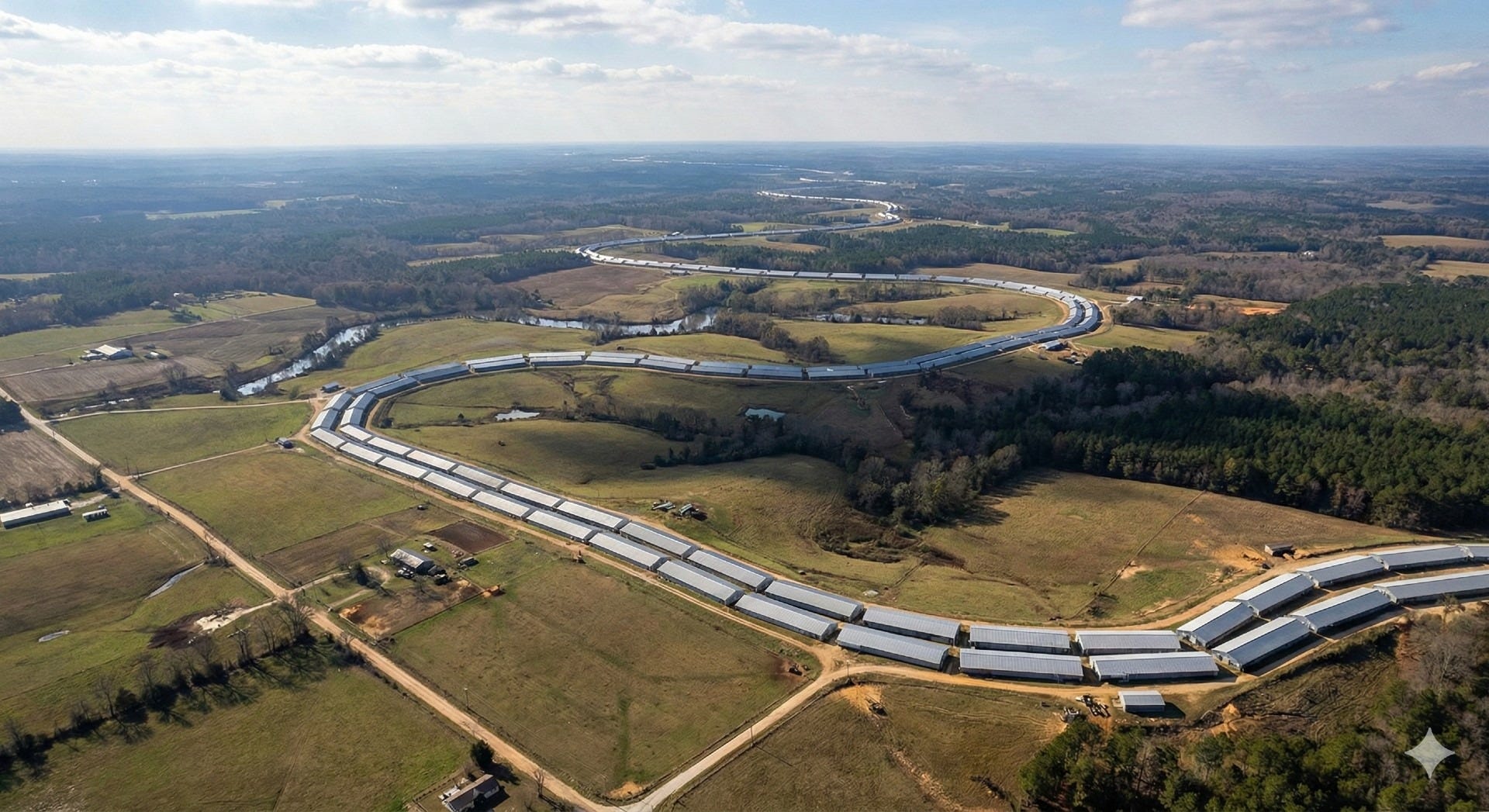
If we assume 3,000 pigs per shed, then the number required to supply the world’s daily pork consumption is 1,300 sheds processed every 24 hours. Every minute, nearly one full shed is slaughtered.
Line up those 1,300 sheds end to end. Assume a standard barn length of roughly 61 m (200 feet). Every day, the world consumes the contents of a line of sheds over 79 km long (49 miles).
Run that for a month and the line stretches from Paris to Moscow, or Manchester to Athens, roughly 2,450 km.
Now add the time lag.
Pigs typically take about 180 days to reach market weight. So for every 1 shed slaughtered today, there must be roughly 180 other sheds already in the production cycle at different stages of growth, just to hold the daily output steady.
That’s what supply means here. To support a global slaughter of 4 million pigs from 1,300 sheds per day, there are roughly 234,000 sheds of 3,000 pigs each active worldwide at any given moment.
Line that many sheds end to end and they stretch 14,274 km. A third of the way around the globe, just shy of the distance between London and Sydney, Australia.
Behind the hard number
A modern pork production system is not a set of independent farms. It is a timed flow from breeding, farrowing, finishing, transport, slaughter, cold chain, and retail. Each stage is coupled to the next. If one stage slows, animals back up, costs rise, and someone pushes the system to restore flow.
That flow is governed by a few hard constraints.
First there is some basic biology and thermodynamics. Pigs turn feed into flesh with losses as heat, movement, and waste. You cannot negotiate those losses away.
Most feed is grown, fertilised, harvested, milled, and transported using high energy inputs. If the energy subsidy changes, the system’s shape changes.
There is a footprint of production with sheds, lagoons, roads, abattoirs, and cropland are all physical. Throughput requires footprint.
Put many animals with near identical genetics together at high densities and disease risk rises dramatically. Biosecurity becomes a real cost of concentration.
The Invisible System Behind the Visible Story
The popular and true story is that pigs are an efficient protein source for people. We should be eating them for a healthy diet.

So we grow pigs commercially. Modern finishing sheds are controlled environments that reduce unit cost by concentrating animals and standardising time, then defend that concentration with infrastructure and protocols. Markets respond to demand that grows as people can access food they enjoy. Consumers choose when they can.
The invisible system is messier.
A concentrated pig pipeline runs on at least four upstream dependencies that rarely appear on a label.
Feed is the true substrate. A market-weight pig eats approximately 3 kg of feed per day. When you multiply that by the 4 million pigs slaughtered daily, it means that roughly 12,000 metric tonnes of feed no longer required to sustain those specific animals for that day. Pork is a way of eating corn and soy indirectly, plus the fuel and fertiliser that made them cheap enough.
Waste is a co-product, not an accident. High density means waste is central, not peripheral and amounts to 23,500 metric tonnes of manure for the daily global flow in 2025. Whether the exact number is right, the underlying reality is stable. Concentration converts dispersed nutrients into a disposal problem that must be managed with land, storage, and regulation.
Biosecurity is the cost of concentration. Hygiene protocols are essential given the speed at which a virus can move through a shed. This is the hidden tax of scaling. You get lower unit costs, then you buy back some safety with surveillance, hygiene, and restricted movement. When that defence fails, consequences are not local. They propagate through the pipeline.
Energy is the silent enabler. Industrial pork is an energy story wearing a protein costume. Feed production, barn climate control, transport, refrigeration, processing. The whole chain is a conversion machine powered by cheap energy. If you remove or constrain that subsidy, the pipeline does not politely shrink. It breaks in specific places first.
This is the missing paragraph in most discussions.
The system is not how we farm pigs. It is how we maintain high daily throughput without acknowledging the upstream energy and nutrient bills.
The Deeper Pattern
There is a recurring institutional pattern here for narratives that preserve innocence at scale.
For consumers, it is comforting to believe the system is just an aggregation of personal choices. For industry, it is profitable to frame scale as inevitability and efficiency as virtue. For policymakers, it is safer to regulate around the edges than to name the dependence on cheap inputs and the fragility created by concentration.
Meanwhile, metrics emphasise what can be counted cleanly at the farm gate while externalities are pushed into the ledgers for waterways, rural air quality, antimicrobial risk, or taxpayer-funded oversight.
And because the pipeline mostly works, the story persists. A stable supermarket shelf and spicy pork from the street vendor is persuasive evidence, even when it is purchased by upstream depletion or hidden risk.
Back to the front
The truck driver and the forklift operator at the loading bay do not care what story you tell yourself about dinner. They care about schedules, weight, refrigeration, and the next slot in the queue; what it takes to do their job.
If you want to think clearly about food, start the day with them. Ignore the label, go live with the pipeline that makes the label possible.
Being a Mindful Sceptic
A mindful sceptic uses curiosity and critical thinking to rigorously question ideas and demand evidence, while being aware of what matters, when it matters, and how to avoid the trap of cynicism.
So what do we do with the hard number of 4 million pigs are slaughtered worldwide each day?
Convert consumption into infrastructure. When you hear millions per day, don’t leave it as an abstract. Translate it into barns, abattoirs, trucks, and standing inventory. If that translation feels obscene, treat it as a clue, not a conclusion.
Track the constraint, not the slogan. Ask what is actually limiting: feed, energy, land, disease, labour, regulation. Better practices that ignore these limiting factors are public relations, not system design.
Interrogate orphan numbers. Any stat without unit, year, geography, denominator, and boundary is persuasion, not information. Tag it, downgrade it, and keep reasoning anyway.
Look for second-order effects. If you improve efficiency, what expands? If you tighten rules, what shifts offshore? If you reduce one harm, what does a new bottleneck appear?
Ask what must stay true for the story to hold. Cheap feed, stable energy, manageable disease, and social permission. If any of those wobble, the system doesn’t politely adjust. Its shape changes.
Even mindful sceptics will have trouble keeping normative, value laden thoughts out of a topic like this one. So here are a few extra pointers to avoid lying to ourselves
Improve measurement hygiene before moral positioning. Demand that major claims about sustainable pork specify unit, year, geography, denominator, and system boundary. Without that, progress claims are mostly rhetorical.
Treat waste and nutrients as system-level design constraints. Any practice change that doesn’t address nutrient leakage, storage, and land application is incomplete, even if it improves animal welfare inside the barn.
Stress-test the pipeline for fragility. Ask where the single points of failure sit: abattoir concentration, feed supply disruption, disease outbreaks. Redundancy costs money. Decide who pays.
Be honest about trade-offs. Lower density may reduce disease spread but it increases land and infrastructure per unit. Higher welfare may raise costs and shift consumption patterns. Those shifts can be desirable, but they are not free.
Consider demand-side realism. If consumption reduces, do it in ways that don’t simply displace harm elsewhere or replace pork with other high-impact substitutes.
Mindful Momentum
This week, do a Protein Ledger Check on one ordinary meal.
Write a small table with these fields:
Protein source
Claimed virtue (cheap, local, humane, sustainable)
Unit, year, geography, denominator, boundary for any supporting stat you believe
Upstream inputs you can name in 60 seconds (feed, energy, fertiliser, transport, waste)
One failure mode (disease, drought, price shock, regulation, social licence)
If you cannot fill the measurement fields, you have learned something useful. Your belief is narrative-shaped, not evidence-shaped.
Key Points
It’s a pipeline, not a product. The mechanism is a continuous, timed flow from feed → barn → abattoir → cold chain, with throughput as the organising principle.
Scale becomes visible when you translate flow into infrastructure. 4 million pigs slaughtered per day globally and 1.4 billion per year in 2025. On a 3,000-pig shed assumption, that’s 1,300 shed equivalents per day.
The real argument lives in constraints and measurement. The binding limits sit upstream in feed, energy, land footprint, waste management, and pathogen pressure while institutional theatre persists because a stable shelf sells and “efficiency” is rewarded even when it increases fragility. The practical move isn’t purity; it’s measurement hygiene plus constraint-aware trade-offs.